


Hydro jetting has become one of the most talked-about plumbing services in the Denver Metro area. Unlike traditional drain snaking, which punches a hole through a clog, hydro jetting uses high-pressure water, typically 3,000 to 4,000 PSI, to scour the entire interior of a sewer line and flush it completely clean.
In older Denver neighborhoods like Congress Park, Park Hill, and Washington Park, tree root intrusion and aging clay sewer lines have made thorough pipe cleaning a growing priority. Across the region, Denver’s hard water compounds the problem by leaving mineral scale inside pipes that snaking cannot remove.
What Is Hydro Jetting?
Hydro jetting is a professional drain and sewer cleaning method that uses a specialized hose and nozzle to deliver water at high pressure into a sewer line. The water stream cuts through grease buildup, mineral scale, tree roots, and other debris, then flushes it all downstream and out of the pipe.
The process begins with a sewer camera inspection to assess the pipe’s condition. This is an important step, hydro jetting is not appropriate for severely deteriorated pipes, where the pressure could cause further damage. Once a technician confirms the line is structurally sound, the hydro jetting head is inserted and the cleaning begins.
A typical hydro jetting session for a residential sewer line in the Denver Metro area takes one to two hours. The result is a pipe interior that is as clean as it was when first installed.
Why Demand Is Growing in the Denver Metro Area
Several factors specific to the Greater Denver Area have driven growing demand for hydro jetting services over the past decade.
Aging Infrastructure in Denver’s Established Neighborhoods
Denver’s older neighborhoods, Congress Park, Whittier, Curtis Park, Baker, and similar areas, were developed between the 1880s and the 1950s. Many homes in these areas still have original clay or cast iron sewer lines that have accumulated decades of buildup. Annual snaking keeps these lines passable but never truly clean. Hydro jetting addresses the root cause rather than just the symptom.
Tree Root Intrusion on the Front Range
Cottonwood, elm, and silver maple trees are common throughout Denver’s residential streets. Their roots are drawn to the moisture and nutrients inside sewer lines and can infiltrate even hairline cracks in older pipe joints. Hydro jetting’s rotating nozzle can cut through root intrusion that a standard snake cannot handle, buying homeowners several more years before a full sewer line repair is needed.
Denver’s Hard Water Leaves Mineral Scale Inside Pipes
Denver Metro’s water supply comes primarily from Rocky Mountain snowmelt, which picks up calcium and magnesium as it passes through the limestone and granite of the Front Range. The result is moderately hard water, typically 150 to 200 mg/L, that leaves white calcium scale on fixtures, appliances, and the interior walls of drain pipes. Over years, this scale narrows drain diameters and causes recurring slow drains that snaking alone cannot resolve.
Hydro Jetting vs. Traditional Drain Snaking
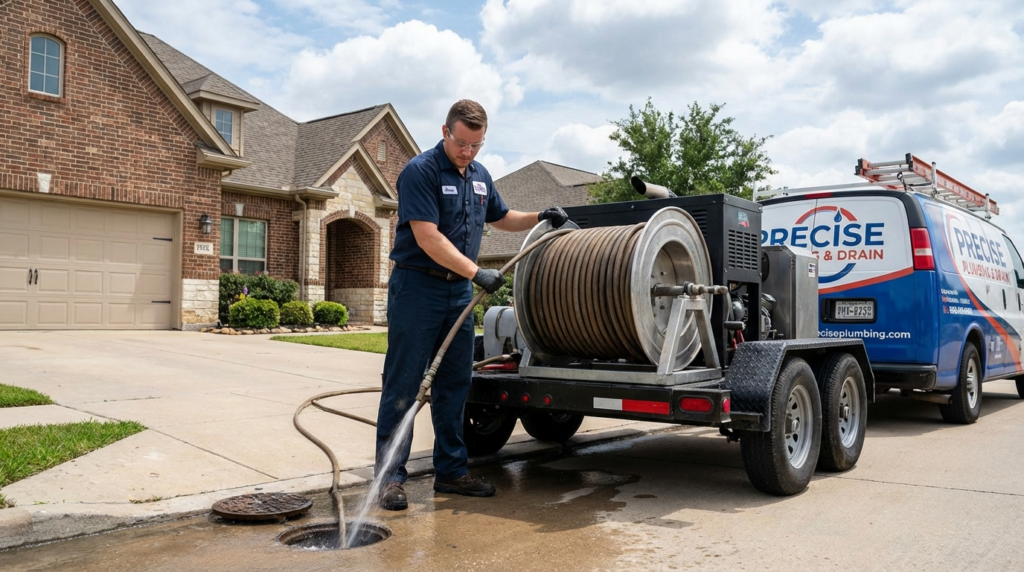
Both hydro jetting and traditional snaking address clogged or slow sewer lines, but they work very differently and are suited to different situations.
A drain snake, also called an auger, uses a rotating metal cable to punch through a blockage. It is fast, affordable, and effective for simple clogs like hair and small debris near a drain opening. However, it does not remove buildup from pipe walls. Within months, grease and scale accumulate again and the blockage returns.
Hydro jetting cleans the full pipe interior. It removes not just the immediate clog but the buildup along the walls that allows future clogs to form. For homes with recurring drain problems, hydro jetting typically extends the time between service calls significantly. Denver homeowners with older homes on clay sewer lines often report that after hydro jetting, they go two to four years without needing any drain service at all.
When Should Denver Area Homeowners Consider Hydro Jetting?
Hydro jetting is the right choice in several situations common to Greater Denver Area homes.
Consider hydro jetting if your home has recurring slow drains that return within a few months of snaking, if multiple drains in the house are slow at once (which points to a main sewer line issue rather than individual drain clogs), if a camera inspection has revealed heavy buildup or tree root intrusion, or if you are purchasing an older home in Denver and want to start with clean sewer lines.
Hydro jetting is also commonly used as a preventive maintenance service by Denver homeowners in older neighborhoods who want to avoid emergency sewer backups, one of the most disruptive and expensive plumbing emergencies a homeowner can face.
What Does Hydro Jetting Cost in the Denver Metro Area?
Hydro jetting costs for residential sewer lines vary depending on line length, degree of buildup, and the extent of root intrusion — pricing is typically in the range of $300 to $600, but your technician will provide an upfront estimate before any work begins. This is generally higher than a standard drain snake, which may cost less for a typical main line clearing — contact Precision Plumbing for current pricing.
However, when factoring in the frequency of service calls, many Denver homeowners find hydro jetting to be more cost-effective over a two to three year period than repeated snaking. A professional evaluation from Precision Plumbing will help determine which approach is most appropriate for your home’s sewer system.
Precision Plumbing’s Sewer Line Services in the Denver Area

Precision Plumbing provides complete sewer line services for homeowners throughout the Greater Denver Area, including sewer camera inspections, hydro jetting, drain clearing, and trenchless sewer line repair and replacement.
Our team serves Denver, Boulder, Arvada, Westminster, Thornton, Aurora, Lakewood, and more than 25 communities across the Denver-Boulder Metro corridor.
For recurring drain problems or to schedule a camera inspection before deciding on hydro jetting, contact Precision Plumbing or call (720) 464-4485.
Frequently Asked Questions
Is hydro jetting safe for older pipes in Denver homes?
Hydro jetting requires a camera inspection first. If pipes show significant deterioration, common in Denver homes with original 1950s or earlier clay sewer lines, hydro jetting may not be appropriate. In those cases, pipe lining or trenchless sewer replacement may be better options. A professional assessment determines which approach is safest and most effective for your specific pipe condition.
How often should Denver homeowners schedule hydro jetting?
For homes in older Denver neighborhoods with clay sewer lines and significant tree cover, scheduling hydro jetting every two to three years as a preventive maintenance measure is common. For newer homes with PVC sewer lines and minimal buildup history, hydro jetting is typically only needed in response to a problem rather than on a fixed schedule.
Can hydro jetting remove tree roots from sewer lines?
Hydro jetting can cut through small to moderate root intrusion and flush root debris out of the line. However, for heavy root intrusion where roots have significantly entered the pipe, full sewer line repair or replacement may be needed. A camera inspection will reveal the extent of root intrusion and guide the right recommendation.
Does hydro jetting damage pipes or pipe joints?
When performed by a licensed plumber on pipes that are in adequate structural condition, hydro jetting does not damage pipes. The risk comes from jetting severely deteriorated or cracked pipes, which is why a camera inspection is required first. Precision Plumbing always inspects before jetting to ensure the process is appropriate for the pipe’s current condition.
How do I know if my Denver home needs hydro jetting vs. a regular snake?
If your drains clear up after snaking but the problem returns within a few months, the buildup on the pipe walls is the cause, and hydro jetting is the more effective solution. If a drain clogs for the first time and responds well to snaking, snaking may be sufficient. A plumber with a sewer camera can give you a definitive answer after inspecting the line.
Is hydro jetting available for commercial properties in the Denver area?
Yes. Hydro jetting is widely used for commercial grease traps, restaurant drain lines, and commercial sewer lines in the Denver Metro area. Commercial properties with high grease output, restaurants, cafes, and food preparation facilities, benefit most from scheduled hydro jetting to stay ahead of grease accumulation and avoid health code violations.
About Precision Plumbing Heating, Cooling & Electric
Precision Plumbing Heating, Cooling & Electric has been serving Greater Denver Area homeowners since 1982. Based in Louisville, Colorado, our licensed plumbers handle sewer line inspections, hydro jetting, emergency plumbing, and complete plumbing services across more than 25 communities in the Denver-Boulder corridor. Call (720) 464-4485 or contact us to schedule a sewer camera inspection or hydro jetting service.