

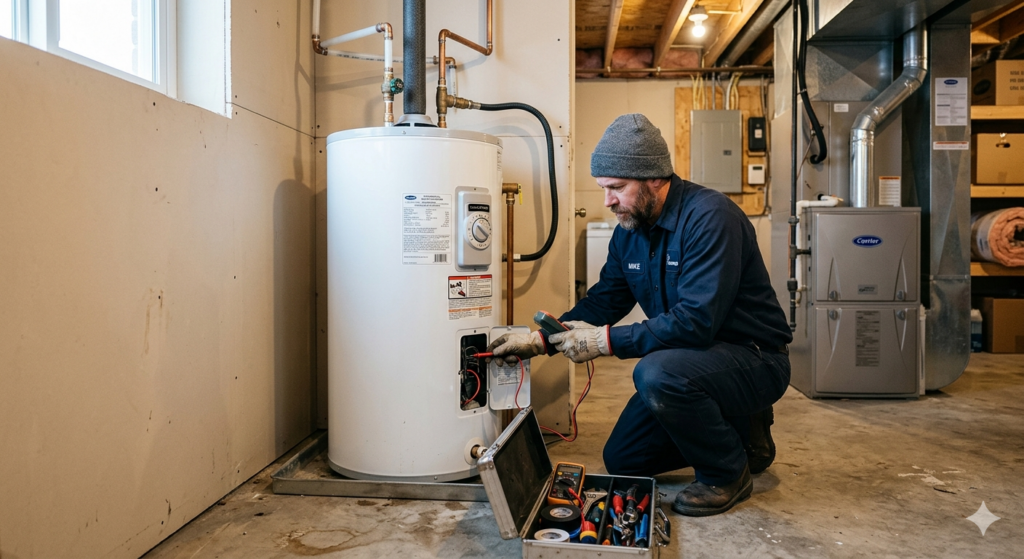
A cold shower at 6 a.m. in a Denver winter is a problem most homeowners only want to solve once. When the water heater stops heating, the cause is usually one of a short list of culprits, and a few of them are safe to check before a plumber ever steps into the utility room. The trick is knowing which ones, in what order, and where the line sits between a safe homeowner fix and a job that needs a licensed pro.
Whether the unit runs on gas or electricity, whether the water is lukewarm or stone cold, and whether the problem just started or has been creeping in for weeks all point to different causes. The walkthrough below covers the most common reasons a water heater stops doing its job in Denver-area homes, what to inspect first, and when to stop turning knobs and pick up the phone.
Key Takeaways
- The most frequent causes of a water heater not heating are a tripped breaker, an extinguished pilot light, a failed heating element, a faulty thermostat, or heavy sediment buildup.
- Electric and gas water heaters fail in different ways and need to be diagnosed differently, so identifying the fuel type comes first.
- Lukewarm water often points to a single failed heating element, a broken dip tube, or sediment insulating the burner or element from the water.
- Denver and Boulder area water is moderately hard, which accelerates sediment buildup and shortens the life of heating components.
- Any gas smell, visible water leak, or scorch marks around the unit should stop troubleshooting immediately and trigger a call for emergency service.
Start With Power, Gas, and the Basics
Before opening any panels, walk through the simplest checks. A water heater that stops heating overnight is rarely suffering a deep mechanical failure on the first try. Begin at the source.
For an electric unit, head to the main electrical panel. Look for a breaker labeled for the water heater that has snapped to the middle or fully off position. Reset it firmly to “on.” If it trips again right away, stop. A breaker that keeps tripping signals an electrical fault that needs professional attention, not repeated resets.
For a gas unit, check the gas shutoff valve on the supply line going into the heater. The handle should run parallel to the pipe in the open position. If anyone has been working in the area, the valve may have been turned without anyone realizing it. Also verify other gas appliances in the home are working. If the stove and furnace are also cold, the issue is upstream of the water heater and likely involves the gas meter or supply.
Then check the thermostat dial on the unit itself. Bumped knobs, especially on garage-mounted heaters, are a more common cause than people expect. The standard recommendation is 120°F. Anything below that and the water will feel barely warm at the tap.
If power, gas, and temperature settings all look correct and there is still no hot water, the next step depends on which fuel type is in the home.
Electric Water Heater Not Heating: Most Common Culprits
An electric water heater not heating almost always points to one of four issues: a tripped high-limit switch, a failed heating element, a bad thermostat, or sediment insulating the elements from the water.
The high-limit switch, sometimes called the ECO or reset button, sits behind the upper access panel. It is a small red button that pops out when the unit detects an over-temperature condition. After cutting power at the breaker, the panel can be removed and the button pressed firmly until it clicks back in. If it pops back out, the upper thermostat or element is failing and needs replacement.
Heating elements are next. Most residential electric tanks have two: an upper and a lower. The upper element heats the top of the tank first; the lower element handles the rest. When only one element fails, the symptoms tell the story. A failed upper element usually means no hot water at all. A failed lower element typically means a small burst of hot water that runs cold quickly. Testing requires a multimeter and the power firmly off at the breaker. Replacement is straightforward for an experienced DIYer but involves draining the tank and handling 240-volt wiring, so most homeowners book a water heater repair visit instead.
Sediment is the quiet killer. As mineral-laden water heats and cools, calcium and magnesium settle to the bottom of the tank, eventually burying the lower element. The element then struggles to transfer heat into the water, runs hot enough to fail prematurely, and may even short out. In the Denver-Boulder area, where city water sources draw from mineral-rich Front Range geology, this happens faster than in many parts of the country.
Gas Water Heater Not Heating: What to Inspect
Gas units have a different set of failure points. With the gas valve confirmed open and the thermostat set correctly, the next stop is the pilot assembly, visible through a small window or behind a removable access cover at the base of the tank.
If the pilot is out, the relight procedure is printed on the side of the unit. The basic sequence is to turn the gas control valve to “pilot,” press and hold the control knob to release gas to the pilot orifice, then push the igniter button while watching for a flame. The knob must stay depressed for roughly a minute after the flame catches so the thermocouple can warm up and signal the valve to stay open. If the flame snuffs out the moment the knob is released, the thermocouple is the prime suspect.
A thermocouple is a small copper rod tipped with a sensor that sits in the pilot flame. When it warms up, it generates a tiny voltage that tells the gas valve to stay open. Over time the sensor corrodes, the connection loosens, or the tip becomes coated with carbon. The fix is a replacement part, but the labor involves disconnecting the pilot supply, burner assembly, and main supply lines.
Other gas-specific failure points include a clogged burner assembly, a failed gas control valve, and blocked venting. A burner that produces a yellow or wavering flame instead of a tight blue cone is dirty or partially blocked. Venting issues can shut down newer high-efficiency units automatically through their safety sensors. Anything past the pilot relight usually warrants a professional diagnostic call, and any persistent gas smell warrants an immediate call along with a gas line repair inspection.
When the Tank Heats but the Water Doesn’t Get Hot Enough
A different problem entirely is a water heater that runs and produces some heat, but never delivers actually hot water at the faucet. The tank works. The output disappoints. Four causes top the list.
The first is undersizing. A 40-gallon tank serving a family of five with back-to-back morning showers will run out of capacity no matter how well it works. If the issue only shows up during peak demand and the water is genuinely hot at the start, the unit may simply not be sized for the household. A water heater replacement sized to actual demand fixes it permanently, and tankless units handle this scenario especially well.
The second is a broken dip tube. The dip tube is a long plastic pipe that delivers incoming cold water to the bottom of the tank, keeping it separate from the hot water at the top. When it cracks or breaks off, cold water mixes directly into the hot supply at the top, producing lukewarm output. Sometimes flakes of white plastic show up at faucet aerators as the tube disintegrates.
The third is sediment again. A thick layer at the bottom of the tank acts as insulation, forcing the burner or lower element to work harder for less effective heating. Annual flushing through a water heater maintenance visit slows this dramatically in hard-water regions.
The fourth, particularly on aging units, is a thermostat that has drifted out of calibration. The dial reads 120°F but the tank actually heats to 100°F. Replacement or recalibration restores normal output.
Quick Diagnostic Comparison: What the Symptom Is Telling You
The symptom usually narrows the possibilities to two or three components. The table below maps the most common patterns to their likely causes and whether the fix is reasonable for a homeowner to attempt or better left to a licensed plumber.
| Symptom | Most Likely Causes | Homeowner Check | Pro Repair |
| No hot water at all (electric) | Tripped breaker, tripped reset button, both elements failed | Reset breaker, press red reset button | Element replacement, thermostat replacement |
| No hot water at all (gas) | Pilot out, gas valve closed, thermocouple failed | Relight pilot per unit instructions | Thermocouple, gas valve, burner service |
| Lukewarm water only | Broken dip tube, one failed element, drifted thermostat | None safe to attempt | Component replacement |
| Hot water runs out fast | Undersized tank, failed lower element, heavy sediment | None safe to attempt | Element service, flush, or replacement |
| Pilot lights but won’t stay lit | Failed thermocouple, dirty pilot orifice, draft | Verify no draft near unit | Thermocouple replacement, burner clean |
| Water heater leaking | Tank corrosion, T&P valve, fitting failure | Shut off water and power | Inspection and likely replacement |
Using the table as a starting point keeps the troubleshooting focused. If two or more symptoms appear together, or if a “homeowner check” doesn’t resolve the issue on the first attempt, the unit needs hands-on diagnosis.
When to Stop Troubleshooting and Call a Pro
Some situations are not DIY territory under any circumstances. Anyone smelling gas near the water heater should leave the home, call the gas utility from outside, and avoid switches, flames, or anything that could ignite vapor. A licensed plumber should inspect the unit before it goes back into service.
Visible water on the floor around a tank is another stop-immediately signal. Tank corrosion failures rarely repair successfully. The unit needs assessment for replacement, and the surrounding area needs to be checked for water damage before flooring or drywall traps moisture. For active leaks, emergency plumbing services can shut down the system safely and prevent further damage.
Age is the other major factor. Most tank water heaters last 8 to 12 years. A unit past the ten-year mark that suddenly stops heating is often telling its owner that repair money is better spent toward replacement. The companion piece on signs your water heater is on its last leg walks through the decision in more detail.
Tankless units add their own wrinkles. Error codes, flow sensor faults, and scale buildup on the heat exchanger all require specialized diagnostic tools, and the proper response often involves a tankless water heater repair call rather than guesswork. Repeated failures, breakers that won’t stay reset, scorching around vents or wiring, and any electrical buzzing all warrant professional attention.
Frequently Asked Questions
Why is my water heater not heating after I reset the breaker?
If the breaker trips again right away, an electrical fault is shorting somewhere in the unit, often a heating element. If the breaker holds but the water still doesn’t heat, a failed upper element, a tripped high-limit switch behind the access panel, or a bad thermostat are the most common reasons. None of those resolve themselves with a reset.
How long should a water heater take to reheat after running out of hot water?
A standard 40 to 50-gallon gas tank typically reheats in 30 to 45 minutes. An electric tank of the same size usually takes 60 to 80 minutes. Significantly longer than that suggests a partially failed element, heavy sediment, or a burner running well below capacity.
Can sediment really stop a water heater from heating?
Yes. In hard-water regions, sediment can build up enough to bury the lower heating element in an electric tank or insulate the burner from the tank bottom in a gas unit. The unit may still run but transfers little heat into the water, and the elements or burner overheat and fail prematurely. Annual flushing keeps the layer manageable.
My gas water heater pilot light keeps going out. What’s wrong?
The most common cause is a failing thermocouple, which is the sensor that tells the gas valve to stay open once the pilot is lit. Drafts, a dirty pilot orifice, or a partially clogged gas line can also cause repeated pilot outages. If relighting the pilot fixes it for a day or two and then it goes out again, the thermocouple needs replacement.
Is it safe to keep using a water heater that produces only lukewarm water?
For short-term use, yes, as long as there are no leaks, no gas smell, and the unit is not making unusual banging or popping sounds. Lukewarm water is rarely a safety emergency on its own. The bigger risk is letting the underlying problem worsen until it triggers a leak or element burnout.
Does Denver-area hard water shorten the life of a water heater?
It can. Moderate-to-hard mineral content settles as sediment over time, which lowers efficiency and stresses heating components. Annual flushing, an anode rod check every few years, and addressing scale at the source can add years of useful service to the unit.
Should I repair or replace a water heater that won’t heat?
A unit under eight years old with a single failed component is almost always worth repairing. A unit ten or more years old that needs major work like a new gas valve, multiple elements, or tank repairs is usually a better candidate for replacement, especially considering efficiency gains in newer models.
Contact Us
When a water heater stops heating, the goal is to get hot water back fast without making the problem worse. Precision Plumbing has been diagnosing and fixing water heater issues across the Denver and Boulder area for more than four decades. Same-day service is available across the metro for both standard tank and tankless systems, and the team handles everything from a single element swap to a full system replacement.
Contact us to schedule a service or report an active leak. After-hours emergency calls are answered around the clock.
About Precision Plumbing, Heating, Cooling & Electric
Precision Plumbing, Heating, Cooling & Electric has served Boulder, Denver, and the surrounding Front Range communities for over 40 years. The team is fully licensed and insured, and trained to handle the specific challenges that come with Denver-area water quality, altitude-affected combustion, and the wide range of equipment installed in homes across the region. From routine maintenance to emergency repair, Precision delivers the on-time, get-it-right-the-first-time service that keeps neighbors coming back.