

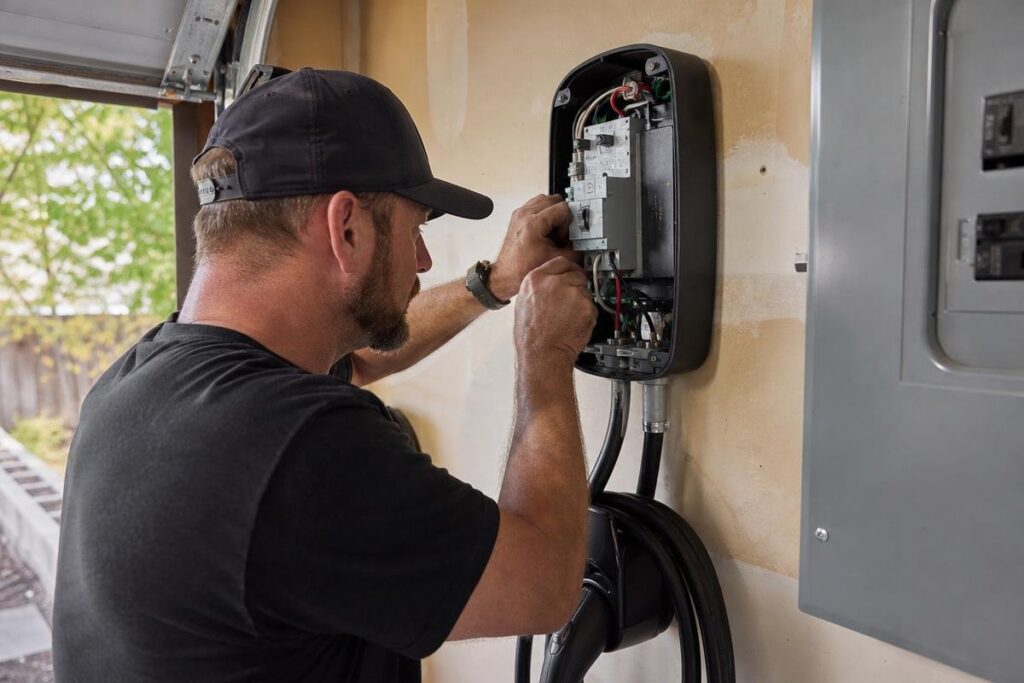
Thinking about EV charger installation in Louisville, CO? You’re not alone. Electric vehicle ownership is growing fast across Boulder County, and more homeowners are ready to ditch the slow 120V outlet and charge overnight at home. We’ve been handling residential electrical work in this area since 1982, and our licensed electricians know exactly what it takes to get a Level 2 charger installed safely, up to code, and ready to use.
Ready to charge smarter at home? Our Louisville team handles the full installation process, start to finish.
Key Takeaways
- EV charger installation in Louisville, CO requires an electrical permit pulled by a licensed contractor.
- Many older Louisville homes need a panel assessment before a Level 2 charger can be added.
- Xcel Energy offers rebates that can reduce your total installation cost significantly.
- A Level 2 charger charges most EVs overnight, compared to days with a standard 120V outlet.
- Our team handles the permit, inspection, and wiring so you don’t have to coordinate anything yourself.
Precision Plumbing Heating, Cooling & Electric has been handling electrical work across the Front Range since 1982. We pull permits, coordinate inspections, and handle the full installation from panel to outlet. If you’re not sure whether your home is ready, that’s exactly what this guide covers.
Here’s what this guide covers:
- The difference between charger types and which one fits your situation
- Real cost ranges for EV charger installation in the Louisville area
- Whether your electrical panel can handle the load
- Permit and inspection requirements from Louisville Building Services
- What actually happens on installation day
If your home is older and you’re worried about your panel, start with our post on signs it may be time to upgrade your electrical panel. Otherwise, keep reading.
Level 1 vs. Level 2 EV Chargers: Which One Do You Actually Need?
Not all home charging setups are equal. The charger type you pick determines how much range you recover overnight, and for most Colorado homeowners driving a Tesla Model 3, Chevy Bolt, or Ford Mustang Mach-E, that difference is significant.
Level 1 (120V): The Slow Lane
What it is: A standard 120V household outlet. No new wiring required.
The problem: You get roughly 3 to 5 miles of range per hour. If you drive 40 miles to Denver and back, you need 8 to 13 hours just to break even. For plug-in hybrids with small batteries, this works fine. For a full battery-electric vehicle, it often falls short.
Level 2 (240V): The Right Choice for Most Louisville Homes
What it is: A dedicated 240V circuit, the same voltage your dryer or range uses. Most residential units run on a 32A or 48A circuit. A 48A charger on a 50A dedicated circuit is the most common setup we install.
What you get: 20 to 30 miles of range per hour, depending on amperage. Plug in at night, wake up with a full charge. That is the right answer for the vast majority of homeowners in the Boulder area.
Older homes in neighborhoods like Old Town Louisville often have 100A panels that need assessment before adding a 240V outlet for EV charger use. Louisville’s mid-century housing stock means many garages sit a good distance from the main panel, which adds wire length to the run. Our team checks your panel before any work starts, and if an upgrade is needed, we tell you upfront.
Not sure your panel can handle a Level 2 charger? Ask us for a free panel assessment before you buy any equipment.
DC Fast Charging: Not a Residential Option
Short answer: DC fast charging requires three-phase commercial power. It is not available in a home setting. You will find it at public charging stations, not in your garage. Cross this one off the list. If your breaker keeps tripping under load, read this guide first before adding a charger circuit.
Our recommendation is straightforward. Go with a dedicated 240V circuit and a quality 48A charger. It handles your daily driving, your mountain trips, and anything else the Front Range throws at you.
What Does EV Charger Installation Actually Cost in Louisville?
Most homeowners in the Louisville area see estimates ranging from $800 to $2,500 for a straightforward home EV charging station install, though your actual cost will vary depending on your home’s electrical setup, panel condition, and where the charger goes. The only way to get a firm number is a walk-through of your home.
Charger Unit Cost
A quality consumer-grade home charging unit typically runs in the $300 to $800 range, though prices vary by brand and features. Hardwired units cost a bit more than plug-in models, but they’re the right call for a permanent install. Smart chargers with Wi-Fi scheduling and energy monitoring sit at the higher end of that range.
Rebate note: Xcel Energy offers up to $500 back on qualifying installations. The federal residential clean energy credit covers 30% of equipment and installation costs, up to $1,000 for eligible homeowners in 2026. Those two together can cut your out-of-pocket cost significantly.
Want to know if your project qualifies for Xcel rebates and the federal credit? Call us and we’ll walk you through the eligibility details.
Electrical Labor and Materials
Licensed electrician labor on the Front Range can vary significantly, with straightforward installs generally falling in the $500 to $1,500 range. Your actual cost depends on your home’s layout and panel location. That includes the dedicated circuit, conduit, outlet or hardwire connection, permit pull, and inspection scheduling. A few things push that number higher:
- Long panel-to-garage runs: More wire and conduit means more time and material.
- Finished garage walls: Running conduit through drywall adds labor.
- Detached garage: A subpanel or underground trench adds real cost fast.
Panel Upgrades: Where Costs Can Jump
This is where the total EV charger installation cost in Colorado can surprise homeowners. Older homes in the Old Town Louisville area often have 100-amp panels from the 1950s through 1970s. A 50-amp charger circuit on an already-loaded 100-amp panel is not safe and usually not code-compliant.
A panel upgrade in this area can add significant cost to the project, depending on your current panel and the scope of work needed. If you’re not sure what your panel can handle, review our post on panel upgrade warning signs before booking your install. The next section also covers panel capacity in more detail.
Our team serves Longmont, Loveland, Littleton, and surrounding communities. If you’re outside Boulder proper, pricing factors stay the same.
Does Your Home’s Electrical Panel Support a Level 2 Charger?
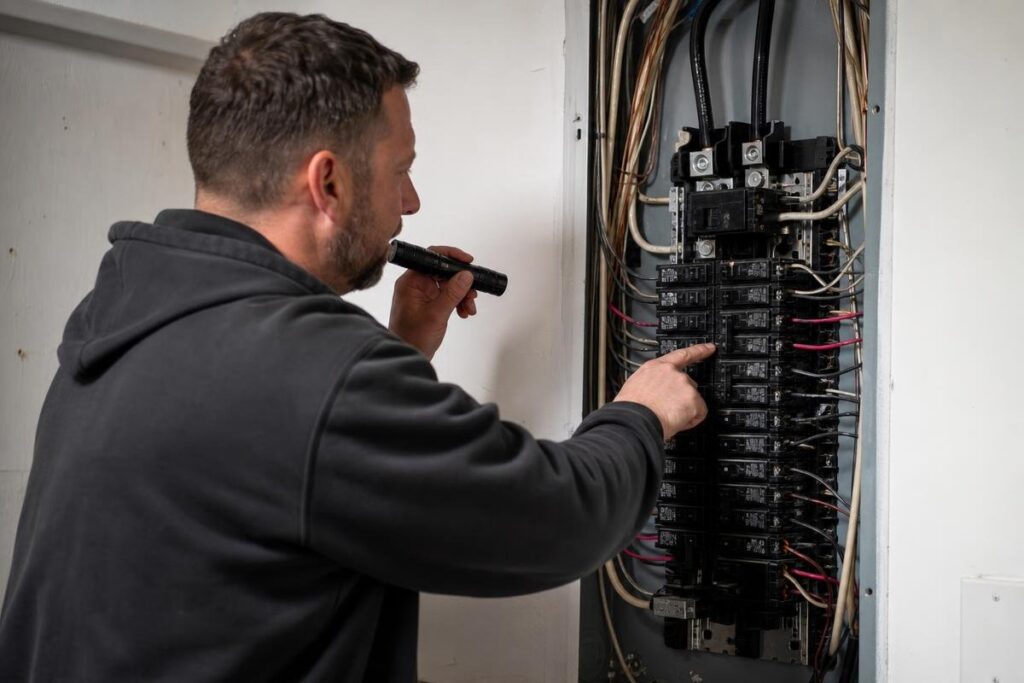
Before you schedule an installation, check your electrical panel. A 240V outlet for an EV charger requires a dedicated 50-amp double-pole breaker. If your panel can’t support that, you need to know now, not on installation day.
How to Do a Basic Panel Check Yourself
This is safe to do with the panel door closed first. Find your main breaker and read the amperage rating printed on it. Most homes show 100A, 150A, or 200A.
- 200A panel with open slots: You’re in good shape. Installation is usually straightforward.
- 150A panel with a few open slots: Likely workable. A licensed electrician can confirm.
- 100A panel with no open slots: Common in older homes along the Coal Creek corridor and Steel Ranch built in the 1950s through 1970s. You need a professional assessment before moving forward.
Open the panel door and count the empty breaker slots. You need two adjacent open slots for that 50-amp double-pole breaker. If you see them, great. If not, keep reading.
What Happens When the Panel Is Full
A full panel doesn’t automatically mean a full panel upgrade. A licensed electrician can sometimes install a tandem breaker, which fits two circuits into one slot, to free up space. It’s a smaller fix that costs less than a full upgrade.
If the panel is genuinely maxed out or undersized, an upgrade is the right call. Older 100A service panels weren’t designed for today’s electrical loads. If your breaker keeps tripping under load, an overloaded panel may already be the cause, and our guide on common breaker-tripping issues is worth reading before you make a decision.
Load Management Devices: A Middle-Ground Option
Not every borderline panel needs a full upgrade. Devices like the Eaton EV Charger Manager or the Emporia Smart Home Energy Management System monitor your home’s total electrical load in real time. When demand spikes, they temporarily reduce charging speed to stay within your panel’s capacity.
This is a real cost-saving option for homes that are close but not quite there. Our team can assess your panel and tell you whether a load management device makes sense or whether an upgrade is the smarter path. Either way, you’ll have a clear answer before any work begins.
Permits and Inspections: What Louisville Homeowners Need to Know
Why a Permit Is Required for EV Charger Installation
Yes, you need a permit. Installing a new dedicated circuit for an EV charger is a permitted electrical job under the City of Louisville Building Services division. No exceptions.
Skipping the permit creates real problems. Your homeowner’s insurance can deny claims tied to unpermitted electrical work. At resale, an unpermitted circuit can stall or kill a deal. It is not worth the risk.
How the Louisville Permit Process Works
Here is the good news: you do not deal with the city yourself. A licensed electrical contractor pulls the permit on your behalf, schedules the inspection, and handles the paperwork. For standard residential projects, Louisville typically turns permits around in a few business days. you pay a small permit fee set by Louisville Building Services, and that is it on your end.
Before installation day, review the home electrical safety checks every Louisville homeowner should make so you know what condition your panel and wiring are in going in. It helps the process move faster.
What the Final Inspection Covers
The city inspector checks three main things:
- The dedicated circuit is correctly sized for the charger’s amperage draw
- The EVSE unit is properly mounted and grounded
- All work meets the 2023 NEC as adopted by Colorado
Once the inspection passes, you receive a signed-off permit. That document is your proof of safe, code-compliant work for your insurance company and future buyers.
Our licensed electricians handle every permit and inspection for your EV charger installation in the Louisville area. Call us at (720) 464-4485 to get started.
What to Expect on EV Charger Installation Day
Most homeowners want to know one thing: how long will this take, and will I be charging my car tonight? For a straightforward home EV charging station install, our team is typically in and out in 2 to 4 hours. Here is exactly what happens, step by step.
Step 1: Panel Assessment and Circuit Planning
Our electrician starts at your panel. We confirm available capacity, check for open breaker slots, and identify the cleanest route to your garage or charging location. If anything looks off, like a panel that is close to its limit, we flag it before a single wire gets pulled. No surprises mid-job.
Step 2: Running the Dedicated 240V Circuit
This is the core of the work. For a 50A circuit, we run 6-gauge wire from the panel to the charger location. For a 40A circuit, 8-gauge wire does the job. In finished garages or homes with brick or stucco exteriors, common on the Front Range, we route the wire through conduit to protect it and keep the install code-compliant. A new double-pole breaker goes into the panel to feed the dedicated 240V outlet for the EV charger.
Step 3: Mounting the EVSE and Final Testing
We mount the charger unit at the right height, wire it to the new circuit, and run a full test. For smart chargers, we verify the unit communicates correctly and walk you through the app setup before we leave. Most Colorado homeowners are plugged in and charging the same day our team arrives. If your breaker trips after installation, our guide on breaker-tripping issues to check first is a useful first reference.
Ready for a firm number? Request an installation quote and we’ll scope your panel, circuit run, and rebate eligibility in one visit.
EV Charging and Your Home’s Energy Use in Boulder
How Much Will Charging Add to Your Electric Bill?
Most electric vehicles use roughly 25 to 30 kWh per 100 miles. At Xcel Energy’s current residential rate of around $0.12 to $0.15 per kWh, driving 1,000 miles a month costs you about $30 to $45 in electricity. Compare that to gasoline, and the savings are hard to ignore. A home EV charging station install pays for itself faster than most homeowners expect.
Your actual bill impact depends on how many miles you drive and when you charge. Charging habits matter as much as the charger itself.
Smart Chargers and Off-Peak Rates
Time-of-use rate plans make overnight charging significantly cheaper. Off-peak hours in Colorado typically run from 9 PM to 6 AM. A smart charger lets you schedule charging automatically so you hit those lower rates every night without thinking about it. Ask our team about qualifying equipment rebates when we scope your installation, since those can meaningfully reduce your upfront project cost.
Pairing EV Charging with Broader Home Energy Upgrades
Many homeowners in Longmont, Lafayette, and Superior are already planning electrical upgrades. Adding an EV charger fits naturally into that work. If you’re already running a new circuit or upgrading your panel, the incremental cost of adding a charger circuit drops considerably.
If you’re weighing a heat pump vs. gas furnace for Louisville homeowners, that decision affects your total electrical load too. And pairing a charger with a smart thermostat gives you real control over your energy use. Colorado’s push toward cleaner energy makes now a good time to bundle these upgrades together.
Frequently Asked Questions
Can I Install an EV Charger Myself?
Technically, Colorado allows homeowners to pull their own permits. But a new 240V dedicated circuit is licensed electrical work. Mistakes on a 240V circuit can cause fires or damage your charger. A licensed electrician makes sure the permit inspection passes the first time. If you want to know whether your panel is ready, read our post on panel upgrade warning signs before scheduling anything.
How Long Does Installation Take?
A straightforward install with an accessible panel and an attached garage typically takes 2 to 4 hours. Conduit runs, panel upgrades, or a detached garage can stretch the job to a full day. We give you a realistic timeline before we start.
What Size Breaker Do I Need for a Level 2 Charger?
Most home chargers need a 50A double-pole breaker on a dedicated circuit with 6-gauge wire. Some 32A chargers run on a 40A breaker with 8-gauge wire. Your charger’s spec sheet and our electrician confirm the right size for your setup. If your breaker keeps tripping, it may be a sign your panel is already overloaded.
Will My Homeowner’s Insurance Cover an EV Charger?
Many policies cover a permanently installed charger as part of the home’s electrical system. The key word is “permitted.” Unpermitted work is frequently excluded from coverage. Pull the permit, pass the inspection, and you are protected.
Are There Rebates or Tax Credits Available in 2026?
Yes. Xcel offers a rebate for qualifying home charger installations. The federal residential clean energy credit covers 30% of equipment and installation costs, up to $1,000 for qualifying homeowners in 2026. Keep your itemized installation invoice for tax filing.
Can I Install a Level 2 Charger in a Detached Garage?
Yes, but it costs more. A detached garage requires underground conduit from the main panel, which means trenching, or a subpanel installed in the structure. Both are permitted jobs. Cost depends on the distance from your main panel to the garage.
Ready to Get Started with Precision Plumbing Heating, Cooling & Electric?
Call (720) 464-4485 to speak with our team directly. We’re ready to answer your questions, walk you through your options, and help you find the right solution for your needs. Whether you’re just starting to plan or ready to move forward, we’ll make the process simple and stress-free.
Reach out today and let’s talk about how we can help.