

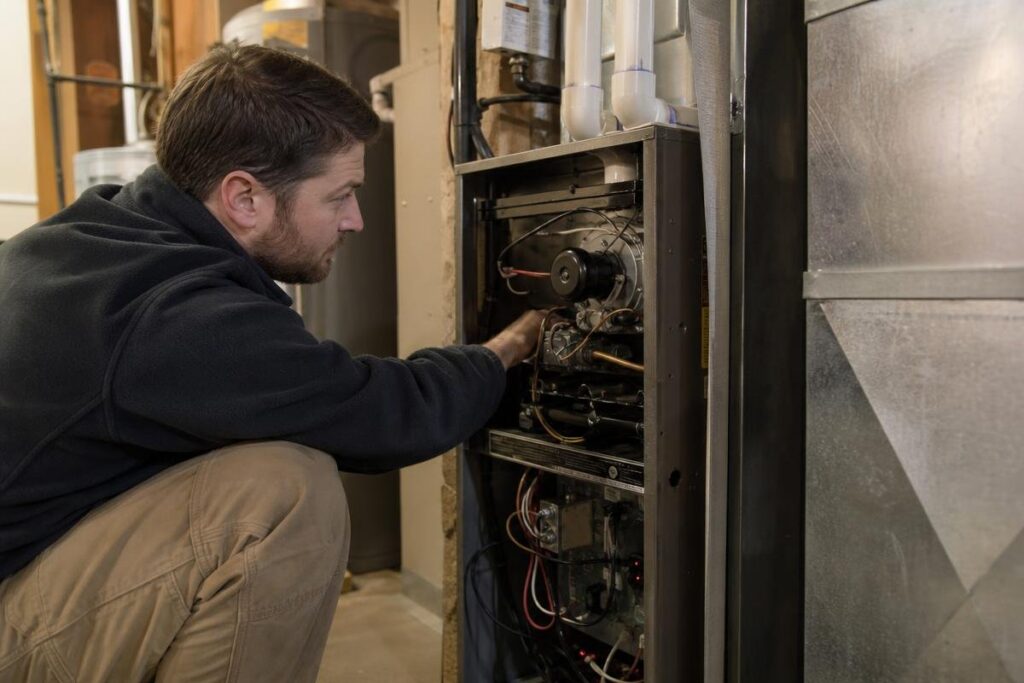
Furnace not heating in Louisville, CO? You are not alone. Colorado winters hit hard, and when the burner runs without warming your home, you need answers fast, not a guessing game. Precision Plumbing Heating, Cooling & Electric has been diagnosing and fixing furnaces in Louisville and the surrounding area since 1982. We are a licensed and insured Colorado HVAC company based right here in Louisville, and we know exactly what causes these systems to fail when temperatures drop across Coal Creek, Old Town Louisville, and the neighborhoods along Highway 36. Below, we cover the 9 most common reasons your furnace is running but not heating your home.
Furnace running but your home is still cold? Our team is ready to help today.
Key Takeaways
- A furnace not heating is often caused by simple fixes like a dirty filter or incorrect thermostat settings.
- Louisville’s cold winters make furnace failures urgent, not just inconvenient, so quick diagnosis matters.
- Ignitor and flame sensor problems are among the most common reasons a furnace runs but produces no heat.
- Some causes are safe to check yourself, but gas-related issues always need a licensed HVAC technician.
- Regular maintenance catches most of these 9 problems before they leave you without heat on a cold night.
Furnace not heating your home on a cold Louisville night? Along Highway 36 and up in Coal Creek, overnight lows can drop into the single digits fast. That is not a situation you can ignore until morning.
The good news: many of these no-heat calls come down to something simple. A wrong thermostat setting. A clogged filter. A tripped circuit. You can check several of these yourself in minutes.
Louisville also sits above 5,300 feet elevation. That altitude affects combustion efficiency in ways that lower-elevation homes never deal with. So some causes here are genuinely different from what you might read in a generic troubleshooting guide.
Below, we cover all nine causes, what to check yourself, and when to call a pro. If you want a head start on prevention, our furnace efficiency guide for local homeowners is a solid place to start.
Why Is My Furnace Running But Not Producing Heat?
In most cases, a furnace that runs without producing heat comes down to a restricted airflow issue, a thermostat setting, or a failed ignition component. Before you call a technician, run through the three checks below. They take less than five minutes each, and a surprising number of these calls turn out to be one of them.
1. Thermostat Settings
This sounds obvious, but thermostat settings are one of the most common causes of a furnace that runs without producing heat. Check three things:
- Mode: Make sure it’s set to HEAT, not COOL or fan-only.
- Set temperature: The target temperature must be higher than the current room temperature. If the room is 68°F and the thermostat is set to 68°F, the furnace won’t fire.
- Fan setting: Set the fan to AUTO, not ON. Fan-ON blows air continuously, even when the burner isn’t running. That constant stream of unheated air feels exactly like a heating failure.
Smart thermostats add one more variable. A power blip or a recent app update can wipe a programmed schedule. Try a manual override and set the temperature to 75°F. If the furnace fires, your schedule got reset, not your furnace. At Louisville’s altitude, some smart thermostat pressure sensors can also read ambient conditions slightly differently, so a manual check is always worth doing first.
2. Tripped Circuit Breaker
Gas furnaces still need electricity. The blower motor, igniter, and control board all run on your home’s electrical system. A tripped breaker cuts all of them at once.
Go to your electrical panel and look for a breaker labeled “furnace” or “HVAC.” If it’s tripped, reset it once. If it trips again immediately, stop. A second trip points to a wiring fault or motor problem that needs a professional. Don’t keep resetting it.
3. Clogged Air Filter
A dirty filter is one of the most overlooked causes of furnace shutdowns. Here’s what happens: a blocked filter restricts airflow, the furnace overheats, and the high-limit safety switch shuts it down to prevent damage. The burner may still cycle, but no warm air reaches your rooms.
Pull the filter out and hold it up to a light. If you can’t see light through it, replace it now. Northern Colorado air is dry and dusty. A filter you changed in spring can be fully loaded by the time October hits. In our Louisville-area service calls, this is the single most common DIY fix we see. Standard 1-inch filters need replacement every one to three months. Thicker 4- to 5-inch media filters last six to twelve months, but our dusty summers eat through them faster than the label suggests. Our HVAC maintenance checklist for Colorado homeowners covers filter schedules in more detail if you want a full seasonal plan.
What Else Causes a Furnace to Run But Not Heat?
You checked the thermostat, swapped the filter, and reset the breaker. Still no heat. Here are six more causes behind a furnace that runs cold. These show up regularly on service calls across Louisville, Superior, and neighboring communities.
4. Pilot Light or Hot-Surface Igniter
Older furnaces built before 2000 use a standing pilot light. If that flame goes out, the burner never fires. Newer units use a hot-surface igniter, a small ceramic element that glows red-hot to ignite the gas. These igniters crack or burn out over time. If your furnace cycles on, you hear the inducer fan spin up, but no heat follows, a failed igniter is a likely cause. This is a technician fix.
5. Dirty Flame Sensor
The flame sensor is a small metal rod inside the burner compartment. Its job is to confirm the burner actually lit. Carbon builds up on the rod over time, and when it does, the sensor can’t read the flame. The furnace lights for a few seconds, then shuts off as a safety measure. That cycle repeats. If your gas furnace lights briefly then shuts down immediately, a dirty flame sensor is the most common reason. Cleaning or replacing it requires a technician.
6. Gas Supply Issue
Check the shutoff valve on the gas line going into your furnace. It should be parallel to the pipe. If it’s perpendicular, it’s closed. Before you do anything else, check your other gas appliances. If your water heater and stove are also out, the issue is upstream. Louisville homes are served by Xcel Energy for natural gas, so you can call the utility directly to check for supply-side outages before assuming the furnace is at fault. If you smell gas at any point, leave the home immediately and call it in. Do not troubleshoot.
7. High-Limit Switch Tripping
The high-limit switch shuts the burner off if the furnace overheats. A clogged filter is the most common trigger, but blocked supply and return vents cause the same problem. Furniture pushed against floor registers is a frequent culprit, especially in the older ranch-style homes around Old Town Louisville. Clear your vents first. If the limit switch keeps tripping after vents are open and the filter is clean, that points to a heat exchanger problem. Get a technician out. A cracked heat exchanger is a safety issue, not just a comfort issue.
8. Clogged Condensate Drain Line
High-efficiency furnaces rated 90% AFUE or above produce condensate water as a byproduct of combustion. That water drains through a PVC line. When the line clogs, a float switch triggers and shuts the furnace down entirely. Your furnace won’t run at all until the clog clears. You can try flushing the line with diluted bleach. If it still won’t run after that, call us. Many local homes upgraded to high-efficiency units after Colorado’s energy code updates, so this cause is more common now than it was ten years ago. If you’re weighing whether to repair or replace an aging system, our guide on how long an HVAC system lasts in this climate is a good starting point.
Still no heat after the DIY checks? Get a free diagnosis from a technician who knows Louisville homes.
9. Ductwork Leaks or Blockages
Your furnace might be heating just fine. The problem is that warm air never reaches the living space. Duct connections in older homes can separate after decades of thermal cycling. Collapsed flex duct or a closed zone damper produces the same cold-room symptom. Our dry winters also accelerate wear on duct seals and gaskets faster than in more humid climates. Check that every register in your home is open and that nothing is blocking airflow. If some rooms are cold and others are fine, duct leakage is worth investigating. Significant leakage requires a professional duct pressure test and sealing. For homeowners thinking about a full system upgrade, our breakdown of furnace replacement tips covers what to expect.
Repair or Replace? How to Decide When Your Furnace Stops Heating
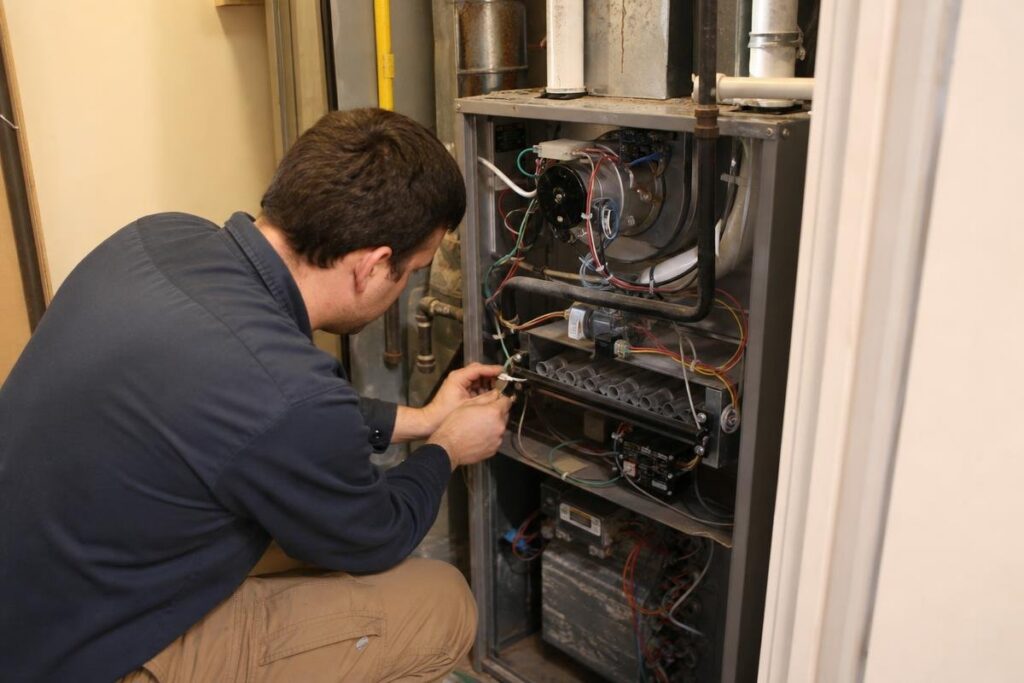
Not every furnace repair is worth doing. Sometimes the smarter move is replacement. Here is a straightforward framework to help you decide, without pressure in either direction.
The 5,000 Rule: A Simple Age-and-Cost Framework
Multiply your furnace’s age in years by the estimated repair cost in dollars. If that number tops $5,000, replacement usually makes more financial sense than repair.
Here is a quick example. A 15-year-old furnace facing a $400 repair gives you 15 x $400 = $6,000. That tips toward replacement. A 7-year-old furnace with the same $400 repair gives you $2,800. That tips toward fixing it.
Efficiency matters here too. Furnaces older than 15 years typically run at 60 to 80 percent AFUE. Modern units reach 96 percent AFUE or higher. On an Xcel Energy gas bill through a Colorado winter, that gap adds up fast. If you want to dig into the numbers, our guide on furnace replacement tips for homeowners walks through what to expect cost-wise.
Warning Signs That Point Toward Replacement
Repair is often the right call. But certain warning signs make replacement the smarter long-term choice. Watch for these:
- Furnace is 15 to 20-plus years old: Most furnaces have a 15 to 20-year lifespan. Older units in area homes are often past their reliable service window.
- Two or more repairs in the past two years: Recurring breakdowns signal a system that is wearing out across multiple components.
- Heating bills rising without a rate increase: Declining efficiency shows up on your gas bill before it shows up anywhere else.
- Uneven temperatures room to room: This often means the system can no longer distribute heat effectively.
- Cracked heat exchanger: This is a hard stop. A cracked heat exchanger allows carbon monoxide to enter your living space. Do not run the furnace. Call a professional immediately. This is a safety issue, not a cost calculation.
If your furnace is showing more than one of these signs, it is worth getting a professional assessment. Our team serves the full Louisville and Boulder County area, including Longmont and Loveland, and can give you an honest read on whether repair or replacement makes sense for your situation.
Not sure if your furnace is worth fixing? Our team can assess it honestly and walk you through your options. Call us at (720) 464-4485 to book a diagnostic visit.
Why Louisville Homes Face Specific Furnace Challenges
Altitude, Dry Air, and Combustion
Louisville sits above 5,300 feet. At that elevation, there is less oxygen per cubic foot of air than at sea level. A furnace that was not calibrated for altitude at installation runs with too much gas and not enough air. That causes sooting, flame sensor fouling, and incomplete combustion. It is one of the most common misses we see when equipment gets swapped without a proper altitude startup procedure.
Winter relative humidity in this area also drops to 20 to 30 percent. That dry air dries out duct seals and gaskets faster than in humid climates. Filters load with fine dust more quickly too. If you want to understand how dry air affects your system beyond the furnace itself, our team can walk you through indoor air quality solutions worth reviewing before winter hits hard.
Older Housing Stock and Aging Equipment
Neighborhoods like Old Town Louisville and the streets near Coal Creek have a lot of homes built between the 1960s and 1980s. Many of those homes are still running original or first-replacement furnaces. That means equipment that is now 20 to 30 years old and well past its expected service life.
Aging furnaces in this housing stock are more prone to flame sensor failure, cracked heat exchangers, and worn igniter components. The original ductwork in many of these homes has never been sealed or pressure-tested. If you are not sure how much life your system has left, our guide on expected HVAC lifespan in this area gives you a clear picture. When overnight lows drop into the single digits, a furnace that is barely hanging on becomes an emergency fast.
Why Louisville Homeowners Call Precision Plumbing Heating, Cooling & Electric
We have been doing furnace repair in Louisville and the surrounding area since 1982. That is over 40 years working on virtually every furnace brand and equipment age you will find in homes from Coal Creek to the properties along Highway 36. Our team operates out of 413 S Arthur Ave in Louisville, CO 80027, licensed and insured in Colorado, and we serve zip code 80027 and the greater Boulder County area every day.
We are a family-owned, woman-led business. That matters to a lot of local homeowners who want an independent company instead of a national chain. You get the same technicians, the same standards, and real accountability every time.
Same-Day Service When Your Heat Goes Out
A heating failure in single-digit overnight temperatures is not something you can wait a week to fix. We offer same-day appointments for heating emergencies. Our team is available Monday through Friday 7am to 6pm and Saturday 8am to 4pm. Call early and we will do everything we can to get someone out the same day.
Upfront Pricing and Real Reviews
We give you the price before we start the work. No surprises on the invoice. That is our promise on every service call.
We have 4,374 reviews with a 4.8-star average. Customers consistently mention that our technicians are knowledgeable, show up on time, and explain what they found in plain language. If you want to stay ahead of problems, our HVAC maintenance checklist for Colorado homeowners is a good place to start.
When your heat quits on a cold night, the smart decision is to call Precision.
Frequently Asked Questions
Why is my furnace running but not producing heat?
The most common causes are a dirty filter blocking airflow, incorrect thermostat settings, a tripped circuit breaker, a failed igniter, or a dirty flame sensor. Start with the simple checks first. Most furnace not heating calls we get come down to one of these five issues.
Can I fix a furnace that’s not heating myself?
Some checks are safe to do yourself. Replacing a clogged filter, resetting a tripped breaker, adjusting thermostat settings, and confirming gas shutoff valves are open are all reasonable DIY steps.
Stop there. Igniters, flame sensors, gas valves, heat exchangers, and electrical components require a licensed HVAC technician. Opening up those parts yourself can void your equipment warranty and create real safety risks. If the simple checks don’t fix it, call a pro.
How much does furnace repair cost in Louisville, CO?
Furnace repair in the Louisville area typically runs between $150 and $600, depending on the part and labor involved. Flame sensor cleaning sits at the lower end. Igniter replacement, control board repair, or heat exchanger work push toward the higher end. We give you upfront pricing before any work starts so there are no surprises on the invoice.
How often should I have my furnace serviced to prevent heating problems?
Once a year, ideally in early fall before the heating season starts. A standard tune-up covers flame sensor cleaning, igniter inspection, heat exchanger check, high-limit switch test, and filter replacement. Those are the components most likely to leave you with no heat mid-winter. Our HVAC maintenance checklist for Colorado homeowners walks through exactly what gets checked and why.
Is it safe to run my furnace if it’s not heating properly?
It depends on the cause. A dirty filter or thermostat issue is low risk. A cracked heat exchanger or gas supply problem is not. A damaged heat exchanger can allow carbon monoxide to enter your living space without any visible warning.
If you smell gas, hear unusual banging, or notice a yellow or orange flame instead of blue, shut the furnace off immediately and call a professional. State code requires working CO detectors on every level of the home. Make sure yours are in place and tested.
How long do furnaces typically last in Louisville-area homes?
Most gas furnaces last 15 to 20 years with regular maintenance. The altitude and dry winters in this area accelerate wear on igniters and heat exchangers faster than you’d see in more humid climates. If your furnace is past 15 years and needs a repair, get a replacement quote at the same time so you can compare costs. Our guide on expected HVAC lifespan in this area breaks down the numbers by equipment type.
Ready to Get Started with Precision Plumbing Heating, Cooling & Electric?
Call (720) 464-4485 to speak with our team directly. We’re ready to answer your questions, walk you through your options, and help you find the right solution for your needs. Whether you’re just starting to plan or ready to move forward, we’ll make the process simple and stress-free.
Reach out today and let’s talk about how we can help.