

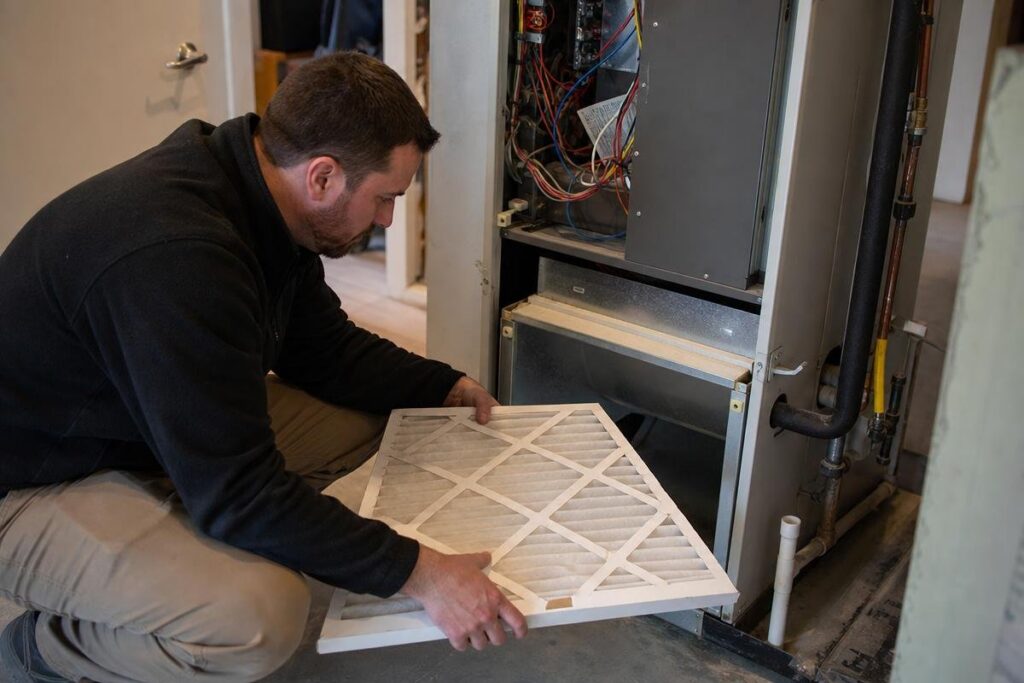
Louisville homes face a tough combination: dry winters that drop indoor humidity well below healthy levels, wildfire smoke seasons that push pollutants inside, and older duct systems that have been circulating the same stale air for decades. Finding the right indoor air quality solutions makes a real difference in how your family breathes every day.
Precision Plumbing Heating, Cooling & Electric has been serving Louisville and the surrounding Boulder County area since 1982, and our team knows exactly what these homes need. Ready to breathe easier? Schedule an indoor air quality assessment today.
Key Takeaways
- Boulder County’s semi-arid climate pushes winter indoor humidity as low as 15%, well below the EPA-recommended 30-50% range.
- Louisville homes benefit most from a layered approach: filtration, ventilation, and humidity control working together.
- Effective indoor air quality solutions include HEPA filtration, UV-C purification, ERV systems, and whole-home humidifiers.
- Aging duct systems in older Louisville homes often need sealing before any air quality upgrade will perform properly.
- Mold risk rises when humidity and ventilation problems go unaddressed, making early testing a smart first step.
Why Colorado’s Climate Creates Unique IAQ Challenges

Seal your home tight against a Colorado winter and you trap more than warmth. At roughly 5,400 feet elevation, the semi-arid climate along the eastern edge of Boulder County pulls indoor relative humidity down to 15 to 25 percent during cold months.
Add wildfire smoke that channels through mountain corridors and settles over Front Range communities, and the air inside your home can carry a mix of fine particulates, dry air, and combustion byproducts that most homeowners never think to measure. According to the EPA, indoor air is often two to five times more polluted than outdoor air. In Colorado winters, when windows stay shut for months, that gap widens fast.
Our team has been working inside homes across the Front Range for decades, long enough to watch these same patterns repeat every heating season. This article covers the four areas that matter most for improving indoor air quality in Colorado homes: filtration, ventilation, humidity control, and air purification. If you want to understand how MERV ratings affect filter performance and airflow, or why humidity levels matter as much as particulate counts, keep reading. Plain answers, no guesswork.
What’s Actually Lowering the Air Quality in Your Louisville Home?
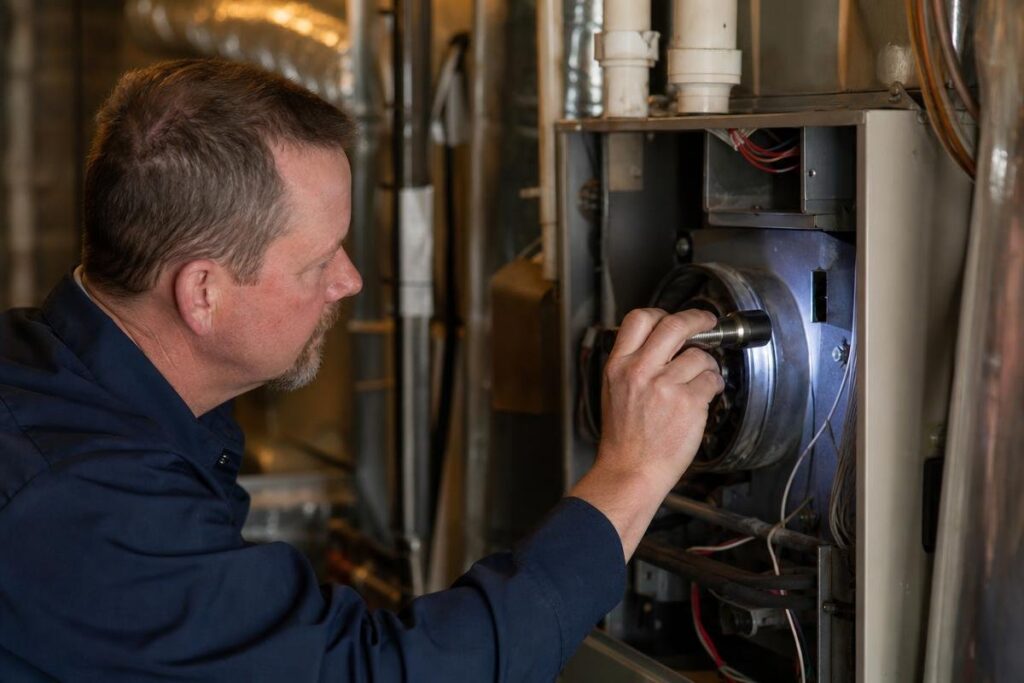
The most common indoor air quality threats in Louisville homes are combustion byproducts, wildfire smoke particles, and VOC off-gassing, not dust. Most homeowners assume the opposite. Each of these real culprits requires a different fix, and a standard furnace filter handles none of them well.
Combustion Byproducts from Aging Furnaces and Water Heaters
An older furnace or gas water heater with a cracked heat exchanger does not just lose efficiency. It can push carbon monoxide, nitrogen dioxide, and fine particulates directly into your living space. Homes built several decades ago near the South Boulder Road corridor are especially likely to have appliances that have never had a full heat exchanger inspection or flue integrity check.
A proper HVAC tune-up covers both. Our technicians inspect the heat exchanger for stress fractures and check flue venting for blockages or back-drafting. If your furnace is more than 15 years old and has never been serviced that thoroughly, you should schedule that inspection before next heating season.
Wildfire Smoke and PM2.5 Infiltration
Wildfire smoke gets inside even when every window is shut. PM2.5 particles, the fine particulate matter that causes the most respiratory damage, are small enough to pass through building envelope gaps and standard duct systems. On the Colorado Front Range, prevailing westerly winds push smoke from mountain corridors directly over the eastern Boulder County communities before it disperses.
The filter in most homes is part of the problem. A standard 1-inch fiberglass filter carries a MERV (Minimum Efficiency Reporting Value) rating of 1 to 4. That captures large dust but virtually nothing in the PM2.5 range. MERV 11 is the practical minimum for smoke filtration.
MERV 13 is better. Our guide to MERV ratings and filter selection explains how filter grade affects both air quality and system airflow. Upgrading to a MERV 13 filter is one of the fastest improvements you can make during Colorado’s wildfire season.
Worried about wildfire smoke infiltration this season? Get a free filter assessment before the next smoke event.
VOCs from New Construction and Renovation
VOCs, volatile organic compounds, off-gas most heavily during the first 6 to 12 months after paint, adhesive, cabinetry, or flooring installation. Louisville’s growing new-construction neighborhoods mean more homes cycling through this high-emission window right now. The 2021 Marshall Fire drove a wave of rebuilds and interior renovations across Louisville and Superior, and many of those homes completed finished work in 2024 and 2025, placing them squarely in that off-gassing period.
Activated carbon filtration captures VOCs that MERV-rated filters cannot touch. Increased mechanical ventilation, either through a heat recovery ventilator (HRV) or an energy recovery ventilator (ERV), dilutes indoor VOC concentrations by bringing in controlled amounts of fresh outdoor air. If your home was recently renovated, those two strategies together are the primary mitigation approach.
The Four Pillars of Effective Indoor Air Quality Solutions
The EPA breaks indoor air quality down into three core strategies: source control, ventilation, and air cleaning. We add a fourth, air purification, because filtration alone cannot catch everything. Together, these four pillars cover the full range of upgrades a Colorado home needs across every season.
Source Control: Stop Pollutants Before They Enter the Air
The cheapest fix is preventing the problem in the first place. Source control means cutting off pollutants at their origin before they circulate through your duct system.
- Remove shoes at the door to avoid tracking in pesticides and particulates from outside.
- Choose low-VOC (volatile organic compound) paints, adhesives, and flooring materials during any renovation.
- Have combustion appliances, furnaces, water heaters, and boilers, inspected annually to confirm they are not back-drafting exhaust gases into living spaces.
- Check gas line integrity in older homes, especially properties built before 1990, where aging connectors are a known concern.
Source control is not glamorous, but it reduces the load on every other system in this list.
Ventilation: Bringing Fresh Air In Without Losing Heat
Opening a window is not a realistic ventilation strategy during a Colorado winter or a wildfire smoke event. Mechanical ventilation is the only dependable option for most of the year in this climate.
An ERV (energy recovery ventilator) exchanges stale indoor air with fresh outdoor air while recovering 70 to 80 percent of the conditioned air’s heat energy. That matters here, where heating costs are significant from October through April. An HRV (heat recovery ventilator) does the same thing but does not transfer moisture, making ERVs the better fit for Colorado’s dry winters where you want to retain indoor humidity rather than exhaust it. \
If you are thinking about improving furnace efficiency during dry winter months, adding an ERV is one of the highest-impact upgrades available.
Filtration: Matching Your Filter to Your Home’s Actual Threats
Not every filter handles every threat. MERV ratings tell you what a filter actually catches.
- MERV 8: Captures most dust, pollen, and pet dander. Good baseline for most homes.
- MERV 11 to 13: Adds fine particles, smoke, and some bacteria. Recommended for homes near wildfire corridors or with allergy sufferers.
- MERV 16 and above: Approaches HEPA territory but requires a compatible air handler. Forcing a high-MERV filter into an undersized blower restricts airflow and can damage the system.
Review our detailed breakdown of how MERV ratings affect filter performance and airflow before upgrading. The wrong filter in the wrong system causes more problems than it solves.
Air Purification: Addressing What Filtration Alone Cannot
Some threats pass right through even a high-MERV filter. VOCs, mold spores on the coil surface, viruses, and ultrafine particles require active purification.
- UV germicidal lights: Installed inside the air handler, these lights kill mold spores, bacteria, and viruses as air passes over the coil. They do not filter particles; they neutralize biological threats at the source.
- Whole-home ionizers and bipolar ionization systems: These units charge particles in the air, causing them to clump together and fall out of circulation or get captured by the filter on the next pass. They are effective against VOCs and ultrafine particles that filtration misses.
A portable air purifier can help in a single room, but it cannot treat air moving through your ducts. For whole-home coverage, purification needs to be integrated into your HVAC system.
How to Choose the Right Air Filtration System for a Colorado Home
The portable HEPA unit sitting in your bedroom is doing its job in that room. But if your home runs 1,800 to 2,500 square feet, most of those units are rated for 200 to 400 square feet. You are not filtering your whole house. You are filtering a corner of it.
Colorado’s wildfire smoke season makes this a real problem, not a theoretical one. A whole-home media filter installed in the return air plenum treats every cubic foot of air your HVAC system moves. That makes MERV 11 or MERV 13 a practical baseline for homes across the Front Range, not an optional upgrade.
Whole-Home Filters vs. Portable Units: What the Numbers Actually Show
A 4-inch or 5-inch media filter in your return air plenum costs less per cubic foot of treated air than running multiple portable units around the house. It also runs on your existing system, so there is no extra energy draw. For most homes in Westminster, Wheat Ridge, or Superior, this is the smarter starting point.
- Portable HEPA units: rated 200 to 400 sq ft per unit
- Whole-home 4-inch media filter (MERV 11 to 13): treats your entire duct system
- Cost per cubic foot of treated air: whole-home wins by a wide margin
- Older homes near Coal Creek Trail with narrow filter slots may need duct modification first
HEPA Bypass Systems for Severe Allergies and Asthma
Here is the catch with true HEPA filters (MERV 17 to 20): your standard residential air handler cannot push air through one without restricting airflow enough to stress or damage the blower motor. A HEPA bypass system solves this by routing a portion of airflow through a true HEPA module while the rest passes through a high-MERV media filter. You get near-HEPA performance without overworking your equipment.
This is the right call for households with severe allergies or asthma. Before going this route, check out why HVAC system sizing affects filter compatibility, because an undersized system makes the bypass math even more important.
Smart Thermostats and Real-Time IAQ Monitoring
Yes, smart thermostat IAQ integration is a real feature, not a marketing checkbox. Thermostats like Ecobee and Nest connect to IAQ sensors and trigger ventilation cycles automatically when CO2, VOC (volatile organic compound), or particulate levels climb past set thresholds. They also track actual runtime hours to remind you when to change your filter, instead of guessing based on a calendar date.
If your system already has a smart thermostat, ask us whether your current setup supports IAQ sensor add-ons. Many homes in Northglenn and Loveland already have the hardware. They just need the sensor paired.
Not sure if your ducts need sealing first? Our team can assess your existing HVAC system and recommend the right match. Call us at (720) 464-4485 to schedule a visit.
Humidity Control: The IAQ Factor Colorado Homeowners Overlook
Most homeowners focus on filtration and forget about moisture. In Colorado’s semi-arid climate, that’s a costly mistake. Humidity swings from dangerously dry in winter to surprisingly damp in summer, and both extremes hurt your air quality and your home.
What 15 to 25% Indoor Humidity Actually Does to Your Home and Health
In January, indoor relative humidity (RH) in an unsealed Colorado home can drop to 15 to 25% without mechanical humidification. The EPA recommends keeping RH between 30, 50% for healthy indoor air. Below that range, your mucous membranes dry out, reducing your body’s natural defense against airborne pathogens. You’ll also notice more static electricity, and over time, hardwood floors and cabinet joints start to crack and separate.
Low humidity also makes you feel colder than the thermostat reads. Your body loses heat faster in dry air, so you crank the furnace higher than you need to. A properly sized whole-home humidifier can offset that effect and trim heating costs. Read more about improving furnace efficiency during dry winter months to see how these systems work together.
Whole-Home Humidifiers: Matching Output to Colorado’s Coldest Months
Not all humidifiers are equal. There are three main types, and the right one depends on your home’s size and how cold it gets.
- Bypass humidifiers are the most common and affordable. They work well for homes under 2,000 sq ft but struggle to keep up during extended cold snaps.
- Fan-powered humidifiers move more air across the water panel and can handle larger homes more reliably through Colorado’s coldest months.
- Steam humidifiers produce the highest output and work independently of your furnace. For homes over 2,500 sq ft or with high ceilings, steam is often the only type that hits target RH consistently.
We install and service all three. Our technicians can measure your home’s square footage, ceiling height, and current duct configuration to match the right unit before you buy anything.
Managing Excess Moisture in Summer and Below-Grade Spaces
Colorado’s summer monsoon pattern brings a different problem. Humidity climbs, and below-grade spaces like basements and crawl spaces trap that moisture with nowhere to go. Mold can establish itself in as little as 48 hours in a damp crawl space.
The primary controls are straightforward:
- Bathroom exhaust fans sized correctly by CFM (cubic feet per minute) to actually move moisture out
- Crawl space vapor barriers to block ground moisture from migrating upward
- Basement dehumidifiers set to maintain RH below 50%
Older homes near Longmont and Westminster with uninsulated crawl spaces are especially vulnerable. If you want to improve indoor air quality across your Colorado home year-round, humidity control on both ends of the spectrum is where to start.
Struggling with dry winter air or a damp basement? Let us measure your home and recommend the right humidity fix.
Indoor Air Quality in Louisville, CO: Local Conditions That Shape Your Options
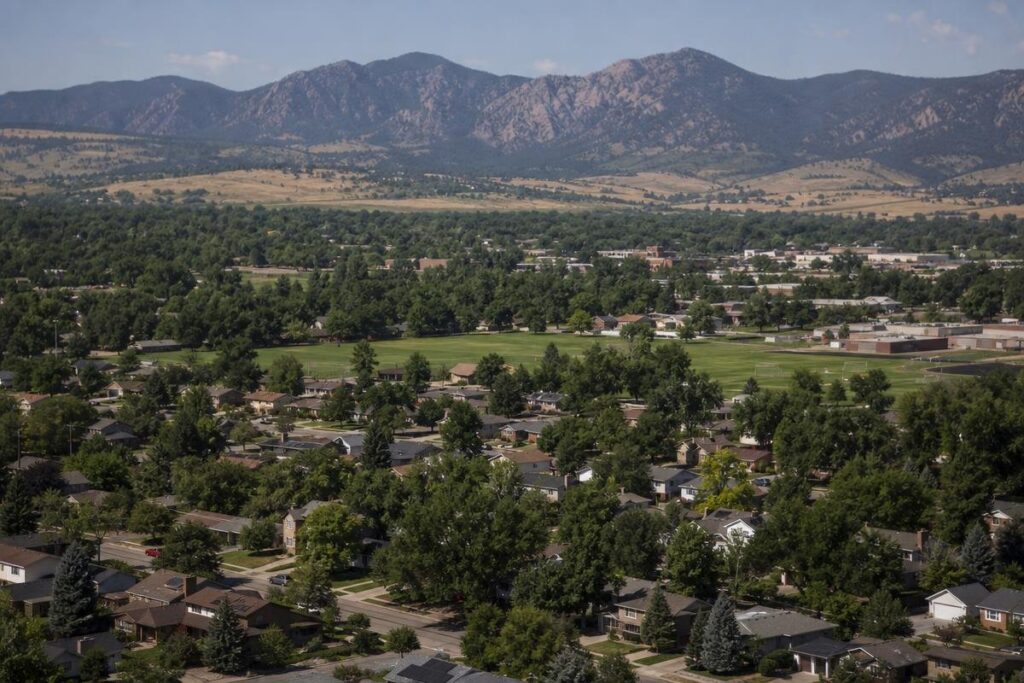
Working out of our office at 413 S Arthur Ave, our technicians drive these neighborhoods every day. That matters because the air quality challenges here are specific to this geography, this elevation, and this housing stock. Generic IAQ advice misses the mark for homes in this corridor.
Elevation, Wind Patterns, and Wildfire Smoke Exposure
At roughly 5,400 feet, this community sits right in the path of prevailing westerly winds that funnel down from the mountain corridors. That geography means wildfire smoke from fires burning above Longmont, Lyons, or deeper in the Rockies hits here before it disperses over the Denver metro. This is not a rare event. It is a seasonal reality.
During active smoke events, outdoor AQI (Air Quality Index) readings regularly climb into the 151 to 200 range, which the EPA classifies as Unhealthy. At those levels, opening windows is not an option. Your only practical defense is whole-home filtration rated MERV 13 or higher running continuously. Many rebuilt and renovated homes in the area now include upgraded filtration and ventilation as standard, not optional, features.
If your HVAC system is still running a MERV 8 filter, it is not built for what this location demands.
Read what your heating system reveals about duct and air quality performance to understand how your equipment handles these conditions.
Older Duct Systems and What They’re Pulling Into Your Air
Many homes near Coal Creek Trail, the downtown historic district, and the older subdivisions off South Boulder Road share a common problem. Their duct systems have never been sealed or pressure-tested. Leaky ducts pull unconditioned air directly from attics, crawl spaces, and wall cavities, bypassing every filter you install.
Signs your ducts may be leaking include uneven room temperatures, dusty registers, and higher-than-expected utility bills. Duct sealing and inspection should happen before you invest in any high-end purification equipment. Spending money on a whole-home air purifier while your ducts are pulling in attic air is like mopping the floor with the faucet still running.
- Rooms that never reach the set temperature
- Visible dust buildup on supply vents
- Musty or stale odors that filtration alone does not fix
- Higher heating and cooling bills with no clear cause
Our HVAC team serving the Louisville area can pressure-test your duct system and tell you exactly where air is escaping before recommending any additional IAQ equipment.
Frequently Asked Questions
What’s the most effective combination of IAQ upgrades for a Colorado home?
Start with a MERV 11 or MERV 13 whole-home media filter, add a whole-home humidifier for dry winter months, and install an ERV (energy recovery ventilator) for fresh air exchange. UV germicidal lights are worth adding if anyone in the household has respiratory concerns or if mold has been an issue. That four-part stack covers filtration, humidity, ventilation, and purification together.
How do I know if my home actually has an air quality problem?
Watch for allergy or asthma symptoms that ease up when you leave the house, dust reappearing on registers within days of cleaning, musty odors in specific rooms, or a history of mold growth. Those are reliable indicators. A professional IAQ assessment with particulate and VOC (volatile organic compound) monitoring gives you objective data rather than guesswork.
What MERV rating should I use for my Louisville home?
MERV 11 to MERV 13 is the practical sweet spot for most homes along the Front Range. That range handles pollen, dust mites, pet dander, mold spores, and wildfire smoke particles without choking airflow in a standard residential air handler. Confirm static pressure tolerance with a technician before going above MERV 13, since higher ratings can strain an undersized blower.
Can my existing HVAC system support a whole-home purifier or upgraded filter?
Most systems built after 2000 can handle a 4-inch or 5-inch media filter upgrade and UV light installation with minimal modification. Older systems with smaller filter slots or undersized blowers may need duct work or a blower upgrade first. A quick system check during your annual tune-up tells you exactly where you stand.
How often should I have my home’s air quality evaluated?
Once a year, aligned with your HVAC tune-up, is enough for most homes. If you have had recent renovations, added a pet, have occupants with asthma, or live near wildfire-prone mountain corridors, bump that to every one to two years with a more thorough evaluation. Colorado’s fire seasons have made that interval more relevant for a lot of homeowners across Longmont, Broomfield, and the surrounding communities.
Can better air filtration actually reduce allergy and asthma symptoms?
Yes. Reducing airborne allergens through filtration and ventilation directly lowers the frequency and severity of symptoms. The EPA identifies source control as the most effective long-term strategy, but upgraded whole-home air filtration provides real symptom relief when sources cannot be fully removed.
Your home’s air quality depends on the right mix of filtration, ventilation, humidity control, and purification. The right mix depends on your home’s age, layout, and your neighborhood’s specific conditions. Call our team at (720) 464-4485 or schedule an IAQ assessment online. We are based at 413 S Arthur Ave in Louisville and serve homeowners across Boulder, Denver, Longmont, Broomfield, and the surrounding Front Range.
Ready to Get Started with Precision Plumbing Heating, Cooling & Electric?
Call (720) 464-4485 to speak with our team directly. We’re ready to answer your questions, walk you through your options, and help you find the right solution for your needs. Whether you’re just starting to plan or ready to move forward, we’ll make the process simple and stress-free.
Reach out today and let’s talk about how we can help.