


Boulder homes built before 1990 often have electrical panels that were never designed to handle today’s loads. If your house is running a heat pump, an EV charger, or even just a modern kitchen, your old 100-amp panel may already be struggling. We’ve served Boulder homeowners for decades, and an electrical panel upgrade is one of the most common calls we get. Here are five signs your home is telling you it’s time.
Not sure if your panel is keeping up with your home’s demands? Schedule a panel capacity assessment and get a straight answer from a licensed electrician.
Key Takeaways
- Older Boulder homes with 100-amp panels often can’t support modern appliances, EV chargers, or heat pumps.
- Flickering lights, tripping breakers, and burning smells are clear signs you need an electrical panel upgrade.
- A 200-amp panel upgrade in the Boulder area typically costs between $1,500 and $3,500 depending on project scope.
- The City of Boulder and Boulder County both require permits for panel upgrades, and Xcel Energy must coordinate the meter disconnect before work begins.
- Upgrading your panel now can prevent fire hazards and make your home eligible for Xcel Energy rebates on electric appliances.
Homes in Boulder’s Newlands, Mapleton Hill, and Table Mesa neighborhoods were built tough. But many are still running on original 100-amp electrical panels from the 1960s, 70s, and 80s. Those panels were never designed to handle EV chargers, heat pumps, or a home office full of devices.
That load mismatch is where problems start. A circuit breaker panel upgrade isn’t just a convenience fix. It’s often a safety issue. If you’re wondering whether your old panel is actually a problem or just an annoyance, this post gives you a straight answer.
We’ll cover five clear signs your panel is struggling, what each sign means for your home, and how to decide whether repair or a full electrical panel upgrade is the right call.
Sign 1: Your Breakers Trip Frequently or Won’t Reset
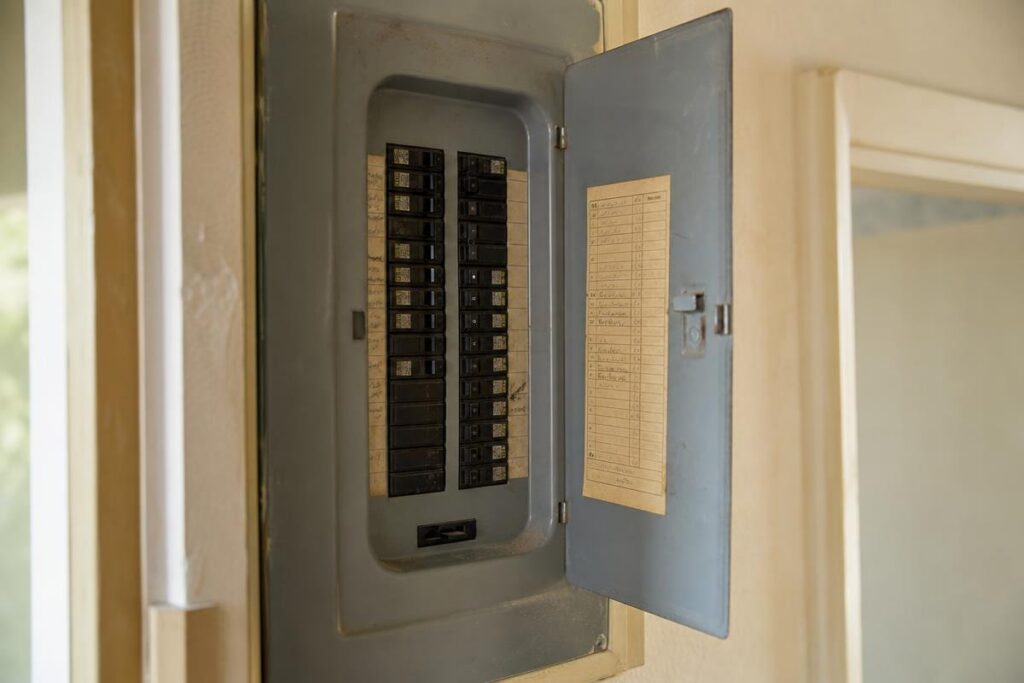
What Frequent Tripping Actually Means
A breaker tripping is not a defect. It is the safety device doing exactly what it should. When current exceeds the breaker’s rated amperage, it cuts power to protect your wiring from overheating. That is the correct operation.
The warning sign is a pattern. If the same breaker trips multiple times a week on a circuit that is not obviously overloaded, something deeper is wrong. If you want to understand why your breaker keeps tripping, it often comes down to one of three panel-level failures:
- The breaker re-trips immediately after you reset it
- The breaker feels warm to the touch or shows scorch marks
- Multiple breakers trip together under normal everyday appliance use
Any one of these points to a panel that has hit or passed its capacity limit. A single-circuit fix will not solve a structural capacity problem.
When Resetting the Breaker Is Not Enough
Homes in older Boulder neighborhoods built before 1990 often still carry an undersized service entrance. Those panels were sized for the loads of that era, not for today’s combination of refrigerators, home offices, electric ranges, and EV chargers running at the same time.
A breaker that holds a trip is a safety device working. A panel that cannot hold a reset has a bigger problem. If a breaker keeps tripping in your Boulder home even after you reset it and reduce the load, that is the panel telling you it cannot distribute power safely across your current demands. At that point, an electrical panel upgrade is not optional. It is overdue.
Sign 2: Your Panel Is 25 or More Years Old
Why Panel Age Matters More Than You Think
A panel that hasn’t caused obvious problems yet can still be a real risk. Panels built before 2000 were designed for homes with far fewer electrical loads. Today’s homes run heat pumps, multiple computers, large TVs, and EV chargers simultaneously. That baseline demand is completely different from what a legacy panel was built to handle.
Physical aging makes this worse. Over time, breaker contacts corrode, bus bars develop hot spots, and the insulation on internal wiring becomes brittle. None of that is visible from the outside. If you live in a home built between the 1950s and 1990s, like many in Boulder’s Glenwood Hills neighborhood, there’s a real chance your panel has never been touched. That’s worth knowing before it becomes a problem.
Specific Panel Brands That Raise Red Flags
Panel age is one issue. Brand is another. Three manufacturers in particular have well-documented failure histories:
- Federal Pacific Electric (FPE) Stab-Lok: These panels have a documented failure to trip under overload conditions. That means the breaker may not shut off when it should.
- Zinsco and GTE-Sylvania: Breakers in these panels can fuse directly to the bus bar, making it impossible to disconnect the circuit.
- Pushmatic: Push-button breakers in these panels are no longer manufactured. Replacement parts simply do not exist, so an electrical panel upgrade is the only path forward.
Check your panel door for the manufacturer name. If you see any of these brands, call us. This is a separate issue from capacity, and it does not wait for a convenient time to become a problem. Not sure if your panel brand is on the problem list? We’ll check it for free during a panel inspection. Call (720) 464-4485.
Sign 3: You Are Adding High-Draw Appliances or an EV Charger
Planning to install a Level 2 EV charger, a heat pump, or a hot tub? Those are smart upgrades. But they carry serious electrical loads, and most original service entrances in older Boulder homes were never designed to handle them.
How New Loads Push an Older Panel Past Its Limit
A Level 2 EV charger needs a dedicated 30 to 50 amp circuit on its own. A heat pump for a typical home draws 15 to 45 amps, also on a dedicated circuit. Add an electric dryer, a whole-home generator, or a hot tub and you are stacking loads a 100-amp panel simply cannot carry alongside the circuits already in your home.
Boulder County has one of the highest EV adoption rates in Colorado, and Xcel Energy rebate programs are pushing more homeowners toward heat pumps every year. If you are weighing that switch, a heat pump almost always requires a panel upgrade in an older home before the new equipment can be installed.
What a 200-Amp Upgrade Actually Gets You
A 200-amp panel upgrade is the standard residential fix. It includes a new main breaker, an updated bus bar, and enough open slots to add dedicated circuits for all of the above without crowding your existing loads.
Some larger homes in the foothills west of Boulder, especially those with workshop or garage loads, may need 400-amp service or a subpanel instead. Our team will assess your actual load before recommending a scope. The goal is capacity that matches where your home is headed, not just where it is today.
- Level 2 EV charger: 30 to 50 amp dedicated circuit required
- Heat pump (3 to 5 ton): 15 to 45 amps, dedicated circuit
- Electric dryer, hot tub, or generator: each needs its own circuit
- 200-amp service: handles all of the above simultaneously
Planning an EV charger install? Schedule a panel capacity assessment first so you don’t hit a stop when the electrician arrives. Call (720) 464-4485.
Sign 4: You Notice Flickering Lights, Buzzing Sounds, or Burning Smells
These three symptoms are not minor annoyances. They are home electrical panel signs that something inside your panel is failing. Treat any one of them as a same-day call, not a weekend project.
What These Symptoms Signal Inside the Panel
Each symptom points to a different type of internal failure:
- Flickering lights when a large appliance kicks on (refrigerator compressor, AC unit, washing machine) means your panel cannot cleanly distribute the load. Voltage drops briefly on the circuit. That is a capacity problem, not a bulb problem.
- Buzzing or humming from the panel box points to a loose connection, a failing breaker, or arcing inside the enclosure. Arcing is not always a bulb or fixture issue either. It can live entirely inside the panel.
- A burning smell or faint odor of melted plastic near the panel means wiring insulation is overheating. Stop using high-draw appliances on affected circuits immediately.
Flickering lights can sometimes trace back to a loose neutral wire at a single fixture. But if the flicker happens every time your AC or refrigerator compressor starts, the panel is the more likely cause. For broader electrical safety tips every homeowner should know, we have a resource that covers common warning signs like these.
Why You Should Not Wait on These Warning Signs
Arcing inside a panel is a leading cause of residential electrical fires. It will not always trip a breaker because the fault is internal, not on a downstream circuit. The breaker has no way to see it.
Older homes across Boulder carry the same risk as any pre-1990 home. Original wiring and aging breaker hardware make these symptoms more likely and more serious. If you smell burning plastic near your panel, call us at (720) 464-4485 before doing anything else. Buzzing, flickering, or burning smells near your panel are not something to watch and wait on. Call our team at (720) 464-4485 and we will get someone out to assess it.
Sign 5: Your Home Has No Room for Additional Circuits
Running Out of Breaker Slots Is a Real Constraint
This sign is different from the amperage issue we covered in Sign 1. A panel can be full of slots even if it is not overloaded on amps. Older 100-amp panels common in Boulder’s mid-century neighborhoods were often installed with just 12 to 20 breaker slots. Today’s National Electrical Code (NEC) requires dedicated circuits for kitchens, bathrooms, laundry, HVAC equipment, and any new high-draw device you add. That adds up fast.
If every slot in your panel is occupied, there is no safe way to add a new circuit without either replacing the panel or installing a subpanel. A panel that looks crowded is not the same as a full one. Count the open slots yourself. If there are none, you have a real constraint on your hands. Our team sees this constantly in homes where previous owners kept adding circuits without ever upgrading the service.
Tandem Breakers: A Short-Term Fix With Long-Term Limits
Tandem breakers, sometimes called double-stuff or piggyback breakers, fit two circuits into a single slot. They are code-compliant in specific situations and only in panel brands that are rated to accept them. Some homeowners use them to squeeze extra circuits into a full panel. That works only up to a point.
A panel packed with tandems is telling you the home has outgrown its electrical service entirely. Installing tandems in a panel not rated for them is a code violation. It is also a clear signal that a circuit breaker panel upgrade is the right call, not another workaround. Our electrical team can assess your panel and tell you exactly where you stand.
What Does an Electrical Panel Upgrade Cost in Boulder?
Most homeowners in the Front Range want a real number before they commit to anything. Here are honest industry ranges for the most common electrical panel replacement cost scenarios we see in this area.
Typical Cost Ranges by Project Scope
The job type drives the price more than anything else. Here is what to expect:
- Panel replacement in kind (same amperage, new hardware): $1,200 to $2,500
- 100-amp to 200-amp panel upgrade: $1,500 to $3,500
- 200-amp to 400-amp upgrade or subpanel addition: $2,500 to $5,000+
A 200-amp panel upgrade is the most common job we do in older neighborhoods like Newlands, Mapleton Hill, and Whittier. Homes built before 1980 almost always need the full service entrance upgraded at the same time, which pushes costs toward the higher end of that range.
What Affects the Final Price in Colorado
National cost guides miss the local variables. In this area, these factors move the number up or down:
- City of Boulder or Boulder County permit fees (the two permit processes are separate and have different fee schedules)
- Xcel Energy meter base upgrade requirement and scheduling for disconnect and reconnect
- Age and condition of the service entrance cable
- New grounding electrode system to meet current NEC (National Electrical Code) standards
- Distance from the panel to the main disconnect
Front Range labor rates run at or slightly above national averages. That is just the reality of doing permitted work in this market. We give you upfront pricing before any work begins, so there are no surprise invoices.
How Boulder’s Older Housing Stock Makes Panel Upgrades More Common
Neighborhoods like Whittier, Glenwood Hills, and the Baseline Road corridor have high concentrations of homes built between 1955 and 1990. Many of those homes still have their original service entrance. That was fine for a household running a refrigerator and a few lamps. It is not fine for a home with an EV charger, a heat pump, and an induction range.
The Front Range has one of the highest EV adoption rates in Colorado. Add in the push toward electric appliances and heat pump technology, and you have a direct collision between new high-draw loads and aging electrical infrastructure. That collision is exactly when to upgrade your electrical panel.
The Electrification Push on the Front Range
Climate action goals across Boulder are accelerating heat pump and electric appliance adoption in older homes. If you are considering an induction range or a heat pump water heater, your panel may not have the capacity. Xcel Energy runs rebate programs, including an Electric Heating Rebate and Whole Home rebates, that can offset part of the cost when you move to electric equipment.
Check Xcel’s current residential rebate page for the latest amounts, since they change year to year. These upgrades often trigger an electrical panel upgrade before any new appliance gets installed.
What Boulder Permits and Inspections Require
Yes, you need a permit for an electrical panel upgrade. The City of Boulder Planning and Development Services handles permits for homes inside city limits. Homes in unincorporated Boulder County fall under a separate county permit process. These are not the same process, and mixing them up causes delays.
Every permitted upgrade requires a rough-in inspection and a final inspection before the panel is energized. Xcel Energy must also coordinate the meter disconnect and reconnect, which adds a scheduling variable to your project timeline. A licensed electrician handles the permit pull and that coordination. DIY panel work risks failed inspections, voided homeowner’s insurance, and real safety hazards. Do not skip this step.
Frequently Asked Questions
How long does an electrical panel upgrade take?
Most residential panel upgrades take 4 to 8 hours and wrap up in a single day. Your power will be off during the work. If Xcel Energy needs to disconnect and reconnect the meter, that scheduling step can add time, so we coordinate that ahead of your appointment.
Will I need to be home during the panel upgrade?
Yes. An adult homeowner or authorized representative must be present for the full job. Our electricians need access to the panel, the meter location, and sometimes an attic or crawlspace. Plan to be there from start to finish.
Does an electrical panel upgrade increase home value?
It does, especially in the Boulder real estate market. A modern 200-amp panel is a standard buyer expectation. Homes with Federal Pacific or Zinsco panels frequently face inspection contingencies or price reductions before closing. Upgrading removes that flag before it costs you a deal.
How do I know if I have a Federal Pacific or Zinsco panel?
Check inside the panel door for the brand name. FPE panels often have orange breaker handles and a “Stab-Lok” label. Zinsco panels may be labeled GTE-Sylvania with color-coded breakers. If you are unsure, a licensed electrician can confirm during a panel inspection.
What is the difference between a panel upgrade and a panel replacement?
A panel replacement swaps out failing hardware at the same amperage. A panel upgrade increases your total amperage capacity, typically from 100 to 200 amps, and requires utility coordination for a new meter base. Both require a permit and a final inspection.
How does Precision Plumbing Heating, Cooling & Electric price panel upgrades?
You get a firm price before any work begins, based on scope, permit fees, and utility coordination. No surprises after the job. Call us at (720) 464-4485 to schedule a panel assessment. We serve Boulder, Longmont, Superior, and the broader Front Range. If any of the five signs in this article sound familiar, a panel assessment is the right next step, not a wait-and-see approach.
Ready to Get Started with Precision Plumbing Heating, Cooling & Electric?
Call (720) 464-4485 to speak with our team directly. We’re ready to answer your questions, walk you through your options, and help you find the right solution for your needs. Whether you’re just starting to plan or ready to move forward, we’ll make the process simple and stress-free.
Reach out today and let’s talk about how we can help.