

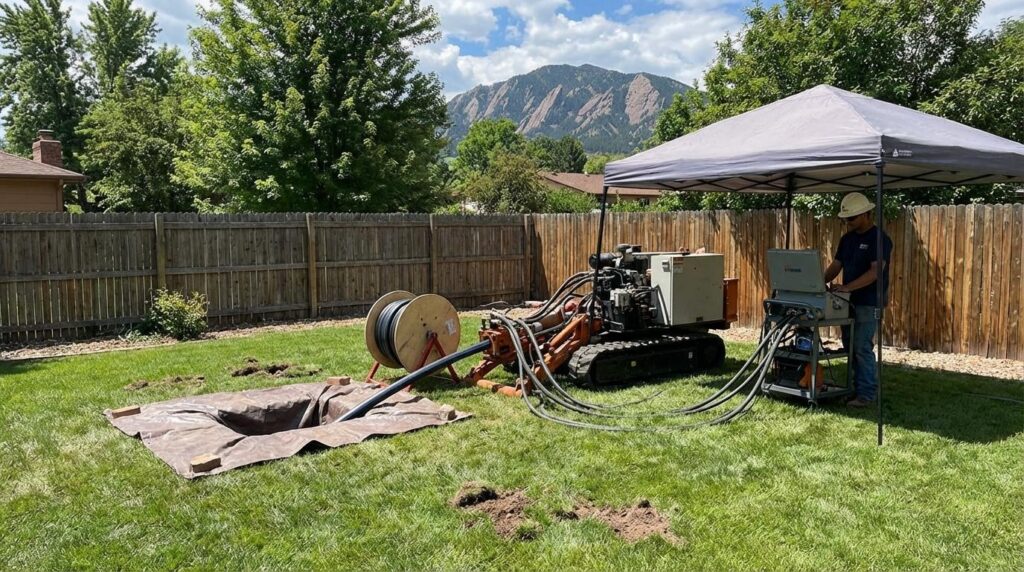
For Boulder homeowners, few plumbing problems are more disruptive than a failing sewer line. Traditional sewer line replacement requires excavating a trench across your entire yard, destroying landscaping, irrigation systems, mature trees, and hardscaping along the way. Trenchless sewer line replacement changes that equation entirely.
Trenchless methods, pipe bursting and pipe lining, allow a licensed plumber to replace or rehabilitate a sewer line with minimal excavation, typically requiring only one or two small access points rather than a full trench. In Boulder, where strict city regulations, rocky Front Range soil, and mature urban landscaping make traditional excavation especially costly, trenchless technology has become the preferred solution for homeowners with sewer line problems.
Precision Plumbing Heating, Cooling & Electric has served the Boulder and Denver Metro area since 1982. Call (720) 464-4485 to schedule a sewer line inspection.
Why Sewer Lines Fail in Boulder Homes
Boulder’s housing stock spans from Victorian-era homes in Mapleton Hill and University Hill to mid-century neighborhoods in Whittier and Martin Acres. Many homes in these established neighborhoods still have original clay tile or cast iron sewer lines, materials that were standard through the 1960s but are now at or past the end of their design life.
Colorado’s climate accelerates sewer line deterioration in ways that are specific to the Front Range. The freeze-thaw cycle, particularly pronounced in Boulder, which experiences 150 to 200 freeze events per year, causes soil movement that cracks aging pipe joints. The region’s large cottonwood, elm, and willow trees send roots toward moisture-rich sewer lines, and Boulder’s rocky substrate can shift after freeze-thaw events in ways that stress pipe connections.
Once a sewer line develops cracks or root intrusion, the only permanent solution is repair or replacement. The question for Boulder homeowners is which method causes the least disruption to their property.
What Is Trenchless Sewer Line Replacement?
Trenchless sewer line replacement is a category of methods that allow plumbers to repair or replace an underground pipe without excavating a continuous trench along its full length. The two primary trenchless methods are pipe bursting and cured-in-place pipe lining (CIPP).
Pipe Bursting
Pipe bursting replaces the old pipe entirely. A bursting head is pulled through the old pipe, fracturing it outward into the surrounding soil while simultaneously pulling a new high-density polyethylene (HDPE) pipe in behind it. The old pipe is destroyed and displaced; the new pipe takes its place.
Pipe bursting requires access pits at each end of the pipe run, typically two holes of about 3 to 4 feet each. No trench is needed along the pipe’s path. HDPE pipe is highly resistant to root intrusion, corrosion, and joint leaks, and carries a design life of 50 to 100 years.
Pipe Lining (CIPP)
Cured-in-place pipe lining rehabilitates the existing pipe rather than replacing it. A flexible liner saturated with epoxy resin is inserted into the damaged pipe and inflated against the pipe walls. Once cured, the liner forms a smooth, joint-free pipe within a pipe, sealing cracks, root intrusions, and joint gaps.
Pipe lining typically requires only one access point and is well suited for pipes with moderate damage. It is not appropriate when the existing pipe has collapsed or is severely misaligned. A camera inspection determines whether lining is feasible for a given pipe run.
Why Trenchless Is Especially Valuable in Boulder

Boulder homeowners face several factors that make the low-disruption advantage of trenchless replacement especially significant.
Boulder’s Urban Tree Canopy
Boulder has one of the most extensive urban tree canopies in Colorado, a feature the city actively protects. Many of these trees have root systems that extend beneath yards and sewer line paths. Traditional excavation to replace a sewer line frequently damages or kills mature trees that took decades to grow. Trenchless methods protect these trees and avoid the cost and timeline of required permit processes for removing city trees.
Rocky Soil and High Excavation Costs
Boulder sits at the base of the Rocky Mountains, and the soil in many neighborhoods contains significant cobbles and rock from the Flatirons formation. Excavating through rocky substrate adds substantially to the cost and duration of traditional sewer replacement. Trenchless methods largely eliminate the need for that excavation, making the cost differential between trenchless and traditional even more favorable for Boulder properties.
Boulder’s Landscape and Hardscape Investment
Boulder homeowners tend to invest heavily in landscaping, irrigation systems, patios, and pathways. A traditional sewer replacement can destroy tens of thousands of dollars of landscaping along the trench line. Trenchless methods leave nearly all of that investment intact, making the cost comparison more favorable than the upfront price difference might suggest.
Signs Your Boulder Home May Need Sewer Line Replacement
Several warning signs indicate that a sewer line problem has progressed beyond simple cleaning and may require repair or replacement. If you notice any of the following, schedule a sewer camera inspection promptly.
Recurring drain backups in multiple fixtures, particularly toilets and floor drains, point to a main sewer line problem. Gurgling sounds from drains when water is used elsewhere in the house suggest a venting or flow obstruction in the main line. Sewage odors inside or outside the home indicate a break in the pipe. Unusually lush or wet patches in the yard above the sewer line path can signal a leak or break underground.
In Boulder homes with sewer lines more than 40 years old, particularly clay or cast iron pipe, a camera inspection is worth doing proactively even without obvious symptoms, since deterioration is often far advanced before visible signs appear indoors.
Cost Comparison: Trenchless vs. Traditional Sewer Replacement in Boulder
Traditional sewer line replacement in Boulder can vary significantly in cost depending on line length, depth, and soil conditions — pricing typically falls in the range of $4,000 to $12,000 or more, and your technician will provide an upfront estimate before any work begins, and that figure does not include landscaping restoration, which can add thousands more for homes with mature plantings, irrigation systems, or hardscaping along the pipe route.
Pipe bursting in the Boulder area generally ranges in cost depending on pipe diameter, length, and access conditions — typical pricing is in the $3,500 to $10,000 range for a residential sewer line, though your technician will provide an upfront estimate. Pipe lining pricing varies by project — contact Precision Plumbing for an upfront estimate based on your specific line. While the upfront cost of trenchless may be comparable to or moderately higher than traditional replacement for some projects, the avoidance of landscape restoration costs often makes it the more economical choice overall for Boulder properties.
An inspection and estimate from Precision Plumbing will provide an accurate cost comparison for your specific property. Contact Precision Plumbing or call (720) 464-4485 to schedule.
Precision Plumbing’s Sewer Line Services in Boulder

Precision Plumbing provides complete sewer line services for Boulder and surrounding communities, including sewer camera inspections, drain clearing, trenchless pipe bursting and pipe lining, and emergency plumbing for urgent sewer backups.
We serve Boulder and more than 25 communities throughout the Denver-Boulder Metro corridor, including Denver, Louisville, Lafayette, Superior, Erie, and Longmont.
Frequently Asked Questions
How long does trenchless sewer line replacement take in Boulder?
Most residential trenchless pipe bursting or pipe lining projects in Boulder take one to two days, compared to three to five days or more for traditional excavation. The timeline depends on line length, access conditions, and the trenchless method used. A camera inspection prior to the project gives a more precise estimate for your specific situation.
Does Boulder require permits for trenchless sewer replacement?
Yes. Sewer line replacement in Boulder, whether trenchless or traditional, requires a permit from the City of Boulder. Precision Plumbing handles the permitting process as part of the project. Boulder’s inspectors must verify that the new line meets current plumbing code requirements, including proper slope and connection to the city main.
Does pipe lining work on Boulder’s older clay sewer lines?
In many cases, yes. CIPP lining works well on clay pipes that are cracked or have joint gaps but remain in their original position and alignment. If a clay pipe has collapsed, shifted significantly, or has sections missing, pipe bursting or traditional replacement may be required. A sewer camera inspection determines which option is appropriate for the specific pipe condition.
What is the lifespan of a new sewer line installed by trenchless methods?
HDPE pipe used in pipe bursting carries a design life of 50 to 100 years and is highly resistant to root intrusion, corrosion, and joint failure. CIPP liner is typically rated for 50 years when properly installed. Both options offer a significantly longer lifespan than the original clay or cast iron pipe they replace.
How do I know if my Boulder home needs pipe lining or pipe bursting?
The primary factor is the current condition of the existing pipe. If the pipe is cracked and leaking but still in its original position and alignment, CIPP lining is often appropriate. If the pipe is severely deteriorated, collapsed in sections, or offset at joints, pipe bursting or traditional replacement is typically needed. A sewer camera inspection is the only reliable way to determine which method is right for your situation.
Will trenchless sewer replacement protect the large trees in my Boulder yard?
Yes, protecting trees is one of the primary advantages of trenchless methods for Boulder homeowners. The process requires only two small access pits rather than a continuous trench along the pipe path. This means the root systems of established trees along the sewer line route are undisturbed, which is a significant benefit given Boulder’s urban tree canopy and the city’s tree protection regulations.
About Precision Plumbing Heating, Cooling & Electric
Precision Plumbing Heating, Cooling & Electric has served Boulder and the Denver Metro area since 1982. Based in Louisville, Colorado, our licensed plumbers specialize in sewer line inspections, trenchless replacement, drain clearing, and complete plumbing services for residential and commercial customers. We serve Boulder and more than 25 communities across the Denver-Boulder corridor. Call (720) 464-4485 or contact us to schedule a sewer camera inspection.